HAKOTO / portach / bog: a sense of otherness through creative practice
On this page
Introduction
What would it sound like if we could hear a peat bog breathing?
HAKOTO means leaf words, leaf sayings, leaf things, leaf incidents and leaf songs. It also refers to leaf memories or leaf stories. Portach is Irish for bog.
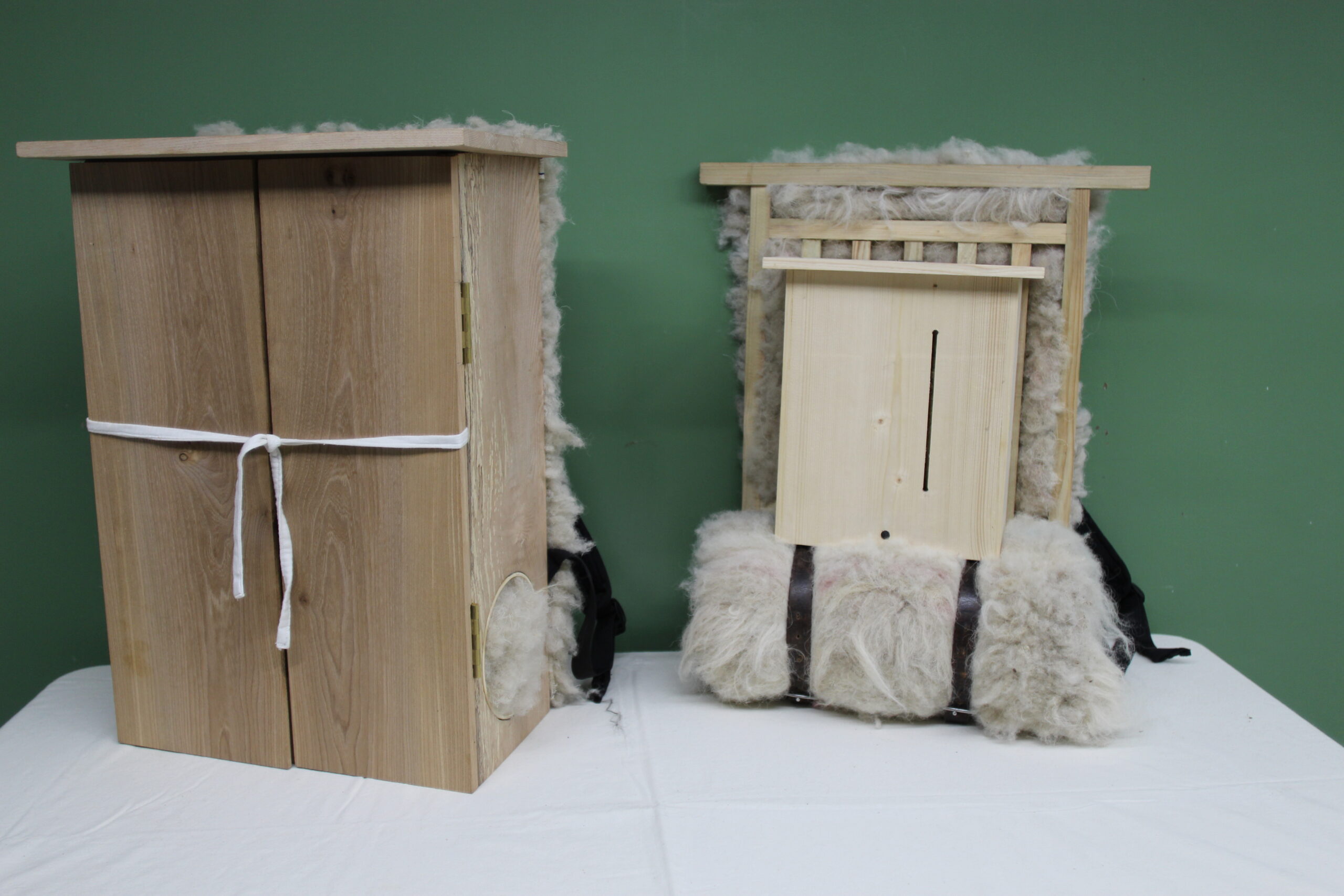
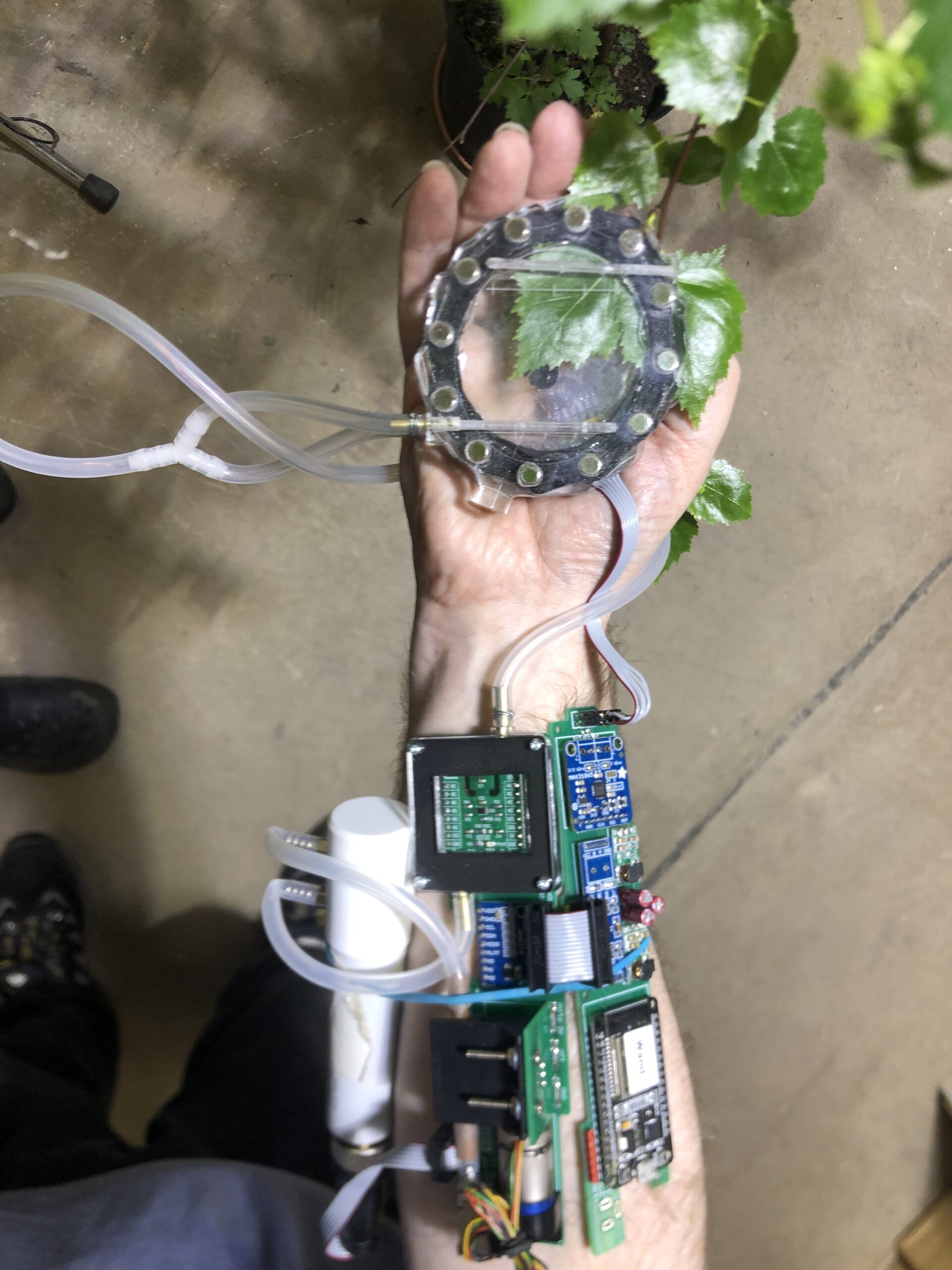
HAKOTO is a body instrument: a wooden backpack of sensors, computers and speakers, worn by the artist, that translates the real-time photosynthesis and transpiration of a living plant into sound. Built in 2022 to listen to tree leaves, in 2023–24 it was rebuilt to listen to sphagnum moss, the living surface of a peat bog.
This page documents that bog work, made during a year-long Landscape, Ecology & Environment Research Residency (LEER) at Leitrim Sculpture Centre, Manorhamilton, Ireland, supported by the Arts Council. The project is concerned with hearing what cannot be heard and seeing what cannot be seen. It engages art and philosophy, a bit of science and a fair amount of technology.
It ends in the exhibition HAKOTO / portach / bog at Leitrim Sculpture Centre, 12 July – 10 August 2024, curated by Seán O’Reilly.
Listen
1
Contexts & Themes
When we are asked what we do and why, we seek out opportunities that challenge our subjective experience and understanding of the world around us. The work can be described as social–ecological practice: being in a place, or being in amongst other beings, in relationship with living entities like boglands. Artwork emerges as a critical, creative reflection upon experiences that are unique and true.
We learned about being with other living things from the work of Helen and Newton Harrison: The Serpentine Lattice, the Sava River project, The Endangered Meadows of Europe. The work also has roots in the early cybernetic experiments of Richard Lowenberg and John Lifton with plants, sensors and sound.
Our reading for this project included John Dupré and Daniel Nicholson’s process philosophy of biology, which understands the living world as processes rather than static things. It also included Frans de Waal on the uniqueness of every species, and John Bellamy Foster on Marx’s “metabolic rift” between humanity and nature, a way into what it has meant for the Irish to be in place with boglands and peat.
Bogland as a theme
The bog work began in 2019, when Offaly County Council and Bord na Móna commissioned Deep Mapping: Lough Boora Sculpture Park (2020). That book was followed by the chapter “Ancient boglands and the Irish Peat Industry: Does Culture Mitigate Ecocide?” (Bloomsbury, 2023).
Boglands, peatlands and cutaway bogs are part of the material condition and social relationship to land in Ireland. The national shift from burning peat to wind and solar seems resolved, but the conflict between turbary-rights holders and conservation policy is not. LEER was a chance to ask what bogs mean in Leitrim, and to listen to them.
2
Sites & Locations
Two research phases: September 2023, to rebuild HAKOTO for bog plants and find a site to test it; and April 2024, for field work. Six bogs were visited in Leitrim, Sligo and over the border in Fermanagh, from active turbary sites to an uncut conservation bog. Clara Bog Nature Reserve in Offaly, a well-restored raised bog, was the reference recording.
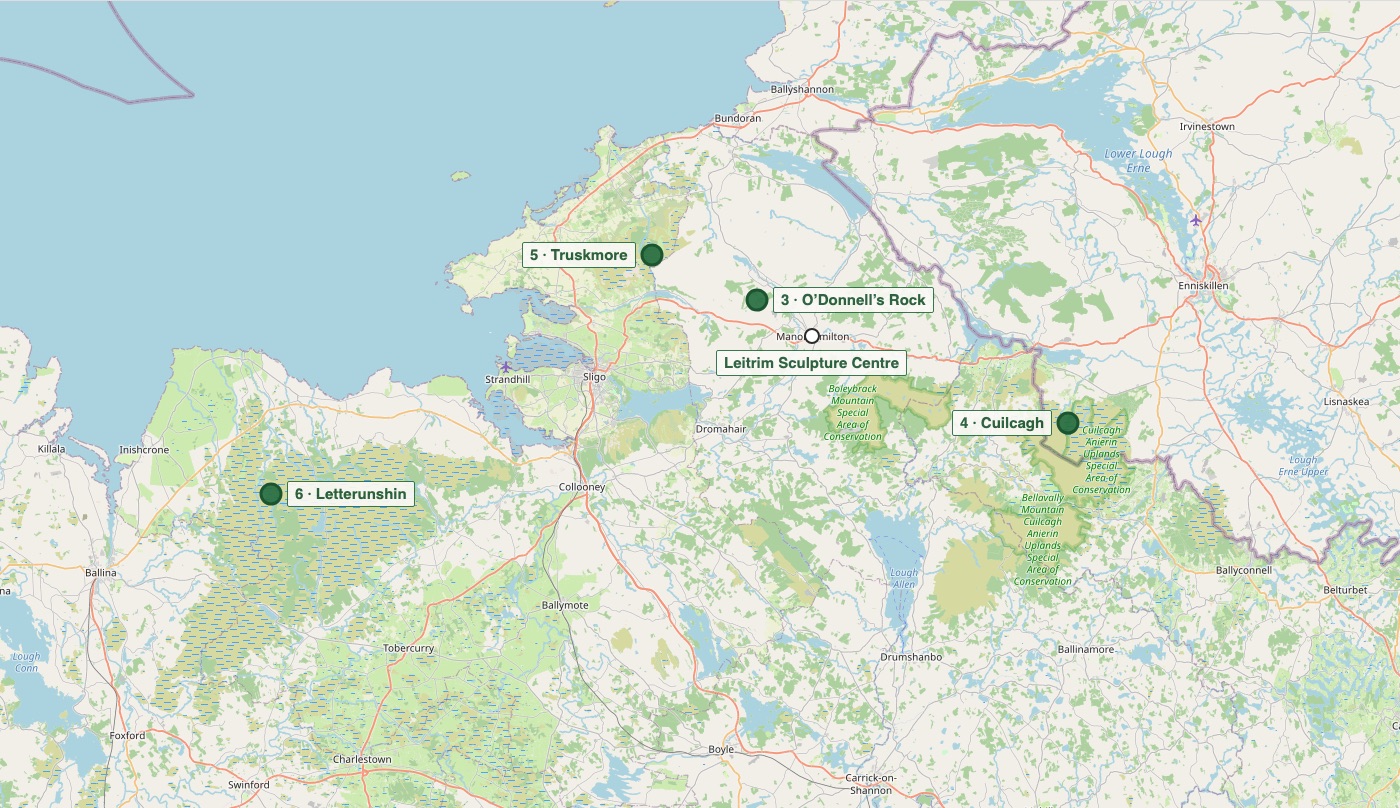
- 1 · Conwal South (23 Sep 2023). An active turbary site above Lough Melvin, with peat in white bags across the cutaway. Windy and wet, but the first time we could hear a bit of the bog.
- 2 · Fenagh (3 Apr 2024). Dave Spence’s family turbary. Dry even after rain, drained, with Coillte plantation drying it further. A secondary site.
- 3 · O’Donnell’s Rock (April 2024, performed). A high plateau of cut bog, with a remnant of wet, living sphagnum sheltered from the wind. Twenty minutes of performance before the rain.
- 4 · Cuilcagh (visited). One of the largest blanket bogs, in a UNESCO Global Geopark: cutaway at the bottom, restored in the middle, pristine at the top. Too tightly managed for this work.
- 5 · Truskmore / Trosc Mór (planned for 6 Jul 2024). A 647 m plateau on the Sligo–Leitrim border; the name means “big cold”. The concluding performance was planned here, then cancelled.
- 6 · Portach Leitir Fhuinseann / Letterunshin (8 Apr 2024, performed). An immense uncut blanket bog in Co. Sligo, suggested by a National Parks and Wildlife Service scientist. “One of the few that … got away.”
3
Research Strategies, Methodologies & Artistic Approaches
Our strategies bring together empathy and the use of sensors, technology and sound to reveal the life signs in a small clump of sphagnum, embedded in a larger ecology. We also educated an artificial intelligence about Irish bogs. If we have done our job as artists, the viewer will recognise the essential otherness of Irish peat bogs that the work both reflects and embodies.
3.1 Empathy
Our enquiry relies on empathy to understand otherness: Einfühlung, “feeling into”, which Edith Stein called “a kind of act of perceiving, sui generis”. It works through careful observation, not knowledge alone. Plants do not share our senses, language or mobility, but they respond to light, temperature, humidity and air. By observing them we can perceive vigour or sluggishness, comfort or discomfort.
The lineage runs back to Plein Air (2010), a sculptural instrument on a painter’s easel that made a tree leaf’s response to the atmosphere audible. It grew out of Reiko’s PhD (2006–2012). Sound was chosen to move away from numbers and graphs, and to appeal to sensitivity and imagination.
3.2 HAKOTO, the instrument
Conceived in 2022 with composer Chris Malcolm, and built with electronics engineer Blair Thompson and artist and systems builder Jim Watt. It is a backpack with sensors, computers and speakers, and an arm piece with a leaf chamber, linked wirelessly. Two sensor sets compare the atmospheric baseline with conditions at the leaf surface: air flow, carbon dioxide, humidity, leaf temperature, air temperature and sunlight. A standard plant-physiology method turns the difference into rates of photosynthesis and transpiration.
For the bog, the team replaced the arm piece with a staff: a long wooden cane carrying the sensors and air pump, and a 10 cm domed chamber set over the sphagnum. The sound takes its structure from the Japanese gagaku court orchestra:
| Plant process | Voiced as |
|---|---|
| Photosynthesis | Fue (flute), Taiko (large drum), Kakko (small drum) |
| Transpiration | Shōko (metal bell), Kakko (small drum), Biwa (lute) |
| Light | Shō (mouth organ) |
Listening to it is something like sitting quietly with an ageing parent, a young child or a beloved partner and attending to the sound of their breath. With time, the depth of experience, and the meaning of the sound of this leafy otherness, expands.
3.3 Artificial – Bog – Intelligence
The artists and Noel Hefele taught an AI, the Bog Whisperer, the history of Irish bogs, peatland ecology and industrial harvest, and the ideas from ecology, industry and philosophy that inform the shift from peat harvest to restoration. It became a discursive partner in a cycle of renga, the Japanese poetic form of alternating stanzas, and images. The cycle runs from the ancient bog through hand-cutting, Bord na Móna and the national energy plan, to restoration, and to dark and light futures.
Ancient Bog
Ancient Irish bogs
Trapping carbon silently
Earth breathes in and out
Local Peatland
Families gather
Harvesting peat with hand tools
Winter’s warmth assured
3.4 Exhibition
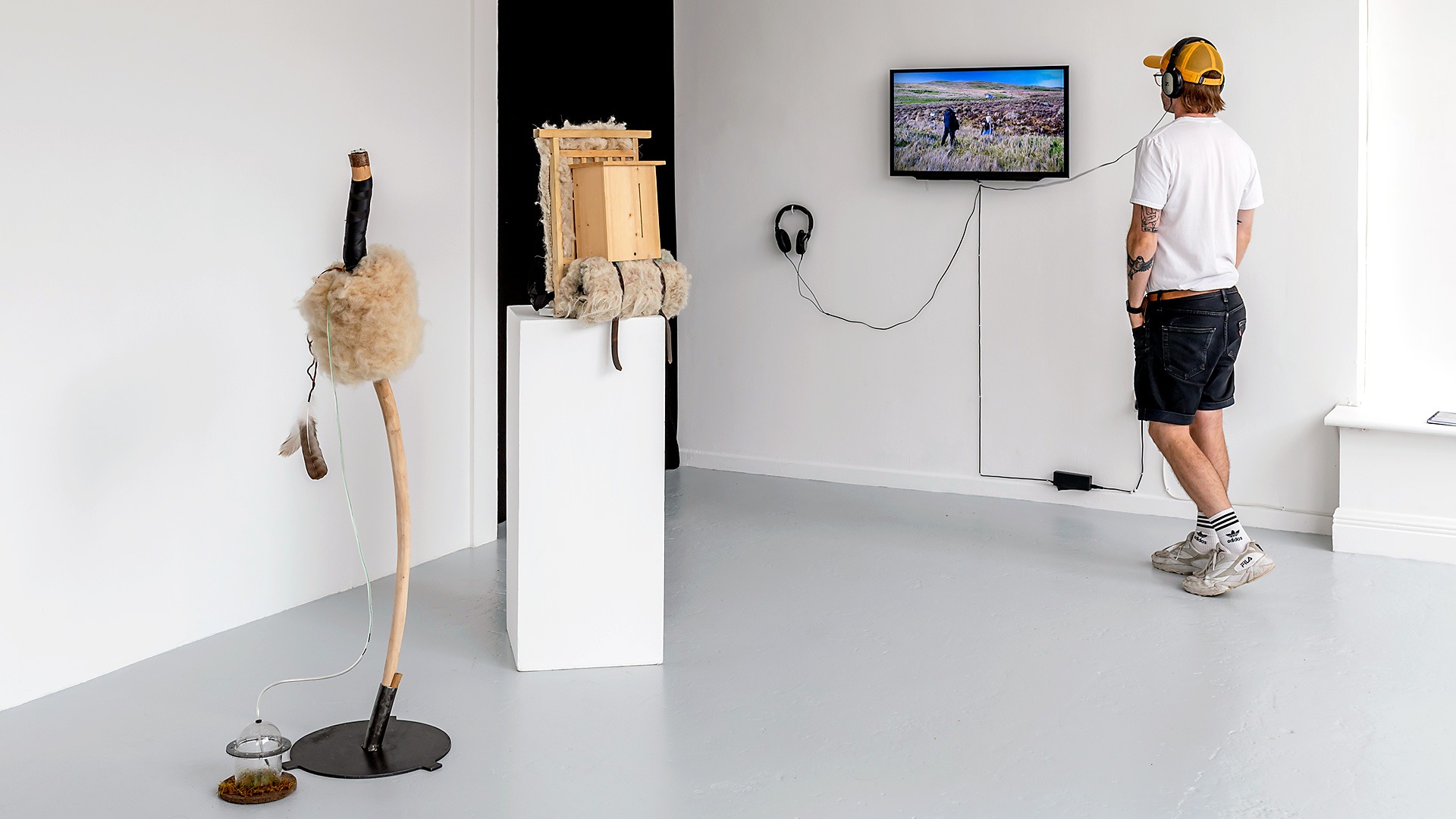
Three elements: a large-format projection of the field performances at O’Donnell’s Rock and Letterunshin; a silent four-screen animation of the Bog Whisperer renga and images; and the HAKOTO backpack and staff, with a live sphagnum chamber on a disc of peat and paper made by the artist John Burne, shown beside a documentary of Reiko in conversation with Dave Spence.
4
Conclusions
Art can be a response to small things. Use your sensitivity to listen to the breath of the bog. Imagine the sight and sound as the spore capsules explode. Feel the energy as the air is filled with an infinity of spores; another cycle begins.
Reiko Goto Collins, 2020
The residency began with a question: how might we start a dialogue about the perception and meaning of Irish boglands in a gallery? We set out to do three things: understand bogs as living entities; deepen our understanding of people and bogs; and build an instrument that would allow practice, and an output, based on the life signs of a peat bog.
Bogs are neither dry land nor water but something in between that denies access and settled meaning. Like the forests we have worked with, they are nature–culture hybrids, transformed over two centuries by capital, culture, industry and technology, and now revalued as carbon stores and habitats. The move from peat harvest to peatland restoration is significant in Ireland. We hope the work contributes in some small way to that discourse.
Does the viewer get a sense of the life forces at play in these places? It is hard to tell. We can attest that most took the time to see and hear the whole piece. This work with bogs continues.
Bibliography
Reading & references
By Collins & Goto
- Collins, T. and Goto Collins, R. (2024) HAKOTO / portach / bog: a sense of otherness through creative practice. Research Portfolio, LEER, Leitrim Sculpture Centre. PDF
- Collins, T. and Goto Collins, R. (2023) “Ancient boglands and the Irish Peat Industry: Does Culture Mitigate Ecocide?” In Jones, O., Parry, B. and Pigott, A. (eds) Rethinking Art and Creativity in an Era of Ecocide. London: Bloomsbury. doi:10.5040/9781350237261.ch-008
- Collins, T. and Goto Collins, R. (2020) Deep Mapping: Lough Boora Sculpture Park. Tullamore: Offaly County Council. PDF
Reading
- Adorno, T. W. (1997) Aesthetic Theory. Minneapolis: University of Minnesota Press.
- Castro, T. (2020) “The 1970s Plant Craze”. Antennae, Autumn 2020, pp. 173–189.
- de Waal, F. (2016) Are We Smart Enough to Know How Smart Animals Are? London: Granta.
- Dupré, J. and Nicholson, D. (eds) (2018) Everything Flows: Towards a Processual Philosophy of Biology. Oxford: Oxford University Press.
- Foster, J. B. (2020) The Return of Nature: Socialism and Ecology. New York: Monthly Review Press.
- Marcuse, H. (2007) Art and Liberation. Ed. D. Kellner. London: Routledge.
- Noble, D. and Noble, R. (2023) Understanding Living Systems. Cambridge: Cambridge University Press.
- Proulx, A. (2022) Fen, Bog & Swamp. London: 4th Estate.
- Stein, E. (1989) On the Problem of Empathy. Trans. W. Stein. Washington, DC: ICS Publications.
- Wheeler, W. (2016) Expecting the Earth: Life, Culture, Biosemiotics. London: Lawrence & Wishart.
- Artists: Helen and Newton Harrison (theharrisonstudio.net); Richard Lowenberg; John Lifton.
The full list, including the Living Organisms reading group papers, is in the Research Portfolio.
Also
HAKOTO elsewhere, 2023–24
- 2023: first public tests, Knockvologan, Isle of Mull (May) · Glasgow, with the Ecotones network (June) · Timber Festival, with Stevie Wishart and Amanda Bayley (July) · Collaborations
- 2024: Cckpt, Düsseldorf and Köln (April–May) · MuseumsQuartier Wien residency (May–June) · Glasgow International, Peace Arbour at Glasgow Women’s Library (June–August) · LEER exhibition, Leitrim (July–August)
- The original proposal: HAKOTO | Speaking Leaf (2023), with a six-minute sound sample · Interviews & Conversations
Credits
People
Collins + Goto Studio, Tim Collins and Reiko Goto Collins, with Chris Malcolm (composition, programming, animation), Blair Thompson (hardware design and programming), Jim Watt (technical artist, hardware) and Noel Hefele (Bog Whisperer development and images).
Curator: Seán O’Reilly, Leitrim Sculpture Centre. Field work with Dave Spence. Exhibition photography: Louis Haugh. With thanks to Shane Finan, Christine Mackey, Maria McSweeney, the Irish Peatland Conservation Council, the National Parks and Wildlife Service, and fellow LEER artists Marielle MacLeman, Noah Rose and Vanya Lambrecht Ward. The Landscape, Ecology & Environment Research Residencies are supported by the Arts Council.