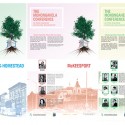
Collins and Goto with Hefele et al
The 2004 Monongahela Residencies were preceded by an international seminar twenty participants to discuss the intent, methods, and means of this area of practice.
The residencies intended to insert artists into three communities that had been severely affected by the economic downturn and the long-term social impact of the post-industrial economy. To support the artists’ work, the entire 3 Rivers 2nd Nature team reconfigured their roles and their office
equipment to provide three public studios for research, outreach and project development. I elected to provide cross-project support, Reiko Goto joined one of the teams, and our research associates—Noel Hefele, an artist, and two architects, Priya Lakshmi and John Oduroe—became site managers. In addition, we hired a young landscape architect to help with design, and two recently graduated artists who had a proven ability to organize, develop, and promote public meetings and events. Each studio was set up with the complete 3 Rivers 2nd Nature database, image store, and contact list. Each site had computer support, mapping software, a printer, a digital camera, Internet, telephone, and various analogue office and creative production
support systems. The landscape architect and outreach coordinators were on call and available to each office with some advance planning. We spent months preparing this infrastructure and developing human resources to enable the success of the artists. As we developed the plan for the residencies, the question from many in the communities was, how much time would the artists spend and how serious would their commitments
to these places be? Our response was to tell the truth, to reveal the scope of the funding and the contractual requests for the artists’ time, and to make it clear that the budgets would likely allow for nothing more than an opportunity for discussion with these artists interested in collaboration, social creativity and change, and that perhaps some illustrated ideas (concept plans) would result. From our point of view, the questions were:
- Could the unorthodox potential of art create a small breach in the day-to-day realities of life in these places?
- Could the artists help initiate or develop a creative nexus in these communities?
We intended a process of engaged creative dialogue that inspired people.
Excerpted from: Collins, T. (2010) 3 Rivers 2nd Nature 2000-2005, Water, Land & Dialogue. In
Carney, L.S., And Pageot, E-A, In a special issue on Landscape, Cultural Spaces, Ecology. RACAR,
Revue d’art Canadienne / Canadian Art Review, Vol 35 Issue 3. Arnprior, ON: Canada Universities Art
Association of Canada.