
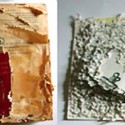
My work Inseparable is based in part on my experiences while observing lovebirds for six years. During my caring for the lovebirds I gave them some nesting materials (wood, straw, and paper.) Soon I discovered they embellished the materials with interesting markings. I present six books. As you see each book has carved differently.
The audio piece I entitled improvisation is an interactive piece. When the glass tube is spun end for end, the movement triggers the switch of the audio. Two lovebirds feathers fall very slowly while accompanied by the improvisational efforts of two accordions and 6 lovebirds.
The final work involves my husband my collective memories of our lovebirds. Placed in a small basket on a stool, the audience is encouraged to take one of these tiny scrolls home.
Music: Joe Zarnich
Electric consulting and fabrication: Robert Kollar
Assistant: Bjorn Hausner

Inseparable
Tim and I have been living with lovebirds for over six years now. Ever since I saw a pair of blue masked lovebirds at a bird store in San Francisco, Their striking appearance never left my mind. Their wings and feathers were many shades of turquoise blue, even their legs were pale blue. Their face and head were black with pale pink beaks. And their large round eyes were curiously encircled in a ring of white. It is not a good idea to make a life commitment with birds based on their appearances. But it is too late now.
Lovebirds recieved their name because of their affectionate nature; the French and German, in fact, refer to them as inseparable , although the females are the dominant sex, as they select the nest site and defend it against other birds. They even snap at their mates! Mutual preening in these species is rather one-sided, the female gets the bulk of the attention.
Scientifically know as genus Agapornis is; they are found in the tropical parts of Africa and on the island of Madagascar. Lovebirds live in small groups in forests, plains, and swamps. “A pair of lovebirds spend the better part of the day together, much of the time on a twig or branch observing the activity all around them in the aviary. Even those lovebirds that enjoy the freedom of the wild always go to roost in pairs and go off together when searching for food.” (Dr. Matthew M. Vriends, Lovebirds .)
I named my two young birds Tristan and Isolde, and called them Tori and Iso. They were relatively untamed quite able to bite us with what Tim describes as “can-opener beaks.” I built a series of large wooden cages for them testing various sunny spots and high and low positions, attempting to make them feel comfortable and “at home.” Eventually they seemed to settle in, they started making rude little nest like piles of newspaper and scraps. I built them a nest box. They were very young couple, and seemed to be discovering what we all assume comes naturally. The way of mating looked very clumsy. Once when I was watching them, they were doing it for five minutes straight! We found five eggs, then ten, and a lot of eggs in their nest box. Soon little piles of eggs were all over the cage, and they did it all the time. However, the eggs never hatched. After while, it became clear to us that the “mated pair” we paid so handsomely for were a happy pair of young gay-birds. They were both female. Then, what were they doing for five minutes? They seemed to be a perfectly happy couple.
Unfortunately two years after they started laying eggs, Iso died suddenly. We worried about Tori, a single young untamed lovebird. I called many bird stores to try to obtain a mate for her. All of them suggested I shouldn’t get a new bird. Lovebirds supposedly mate for life. I was told that introducing a new bird to the cage would most likely end up in bloody fights. They also suggested Tori would be all right as a single bird. Initially she became depressed. Looking at a mirror all day long without moving. Her dropping became a small mountain cumulating in the single spot that marked her depression. Other time she laid eggs, and sat on them forever. She tore her chest feathers. Once we clipped her wings to attempt to handle her and make her friendly to us. It was a big mistake. She became more frightened and miserable. What will a single bird do if the other one dies? Lovebirds could live for fifteen years easily. I hoped she would be happy again. What is happiness for a lovebird all alone?
I started reading many books to find the answer. I came across this statement that describes their life in the wild; “…many times I tried to creep up on them and take photographs with a 500 mm telephoto lens, but they discovered me too soon every time, then emitted loud, shrill warning cries and flew off amidst high pitched twittering…in cereal, millet, corn, and rice fields lovebirds may gather in flocks of 100 to 200 birds and become serious pest. Far worse than the damage they cause through eating is the incidental destruction of crops. Because of their intelligence, alertness, and speed, they usually manage to escape unhurt when the farmers go after them” (Handbook of Lovebird by Dr. Manfred Heidenreich.) I used to think our birds had an evil spirit. They bit us, made shrill call when we were talking (we could not hear our own conversation), they chewed things that were important objects for us such as a payroll check and new window trim. Dr. Manfred’s statement made me understood they were not evil but wild and smart.
Five years later, our neighbor gave us a single lovebird that he had found in the local park. Coincidently the bird was blue masked lovebird. Our neighbor kept him for a while, but gave up because of its strange biting behavior. It was half tame, liking people, readily flying to your shoulder. We could touch it with any part of our body except our hands. We decided to keep the bird, but in a separate cage. The new bird looked at and called Tori, but she neither looked nor called back. Once in a while, I opened the cages, and let them fly in our studio. They flew opposing course, never becoming friends. However, Tori’s behavior became much more normal and less depressed. Tim named the new bird The word Ai had two different meanings in Japanese; one was indigo color and the other one was love. It soon became obvious that our little new friend was indeed a he. Ai was a very mischievous and curious bird. He landed on us, and ate food with us except from our hands.
In the summer 1994, we moved to Pittsburgh Pennsylvania for a job. We drove a large truck across the country. I made a special birdcage that had a division wall between Tori and Ai. According to Tim, they seemed to enjoy the travel. They chirped and sung all way through the journey. After Tim emptied the truck, he flew back to San Francisco again. This time, Tim and I drove our station wagon with a rabbit, a pigeon, and tree frogs. Tori and I had to be in the new place by themselves with a pile of birdseed and bowls of water for five days.
I decided to put them in a cage together. I felt after the trip they might be friendly to each other. Indeed, they became a couple. We placed their cage temporally near the windows that were facing to West. Every evening, they were watching the sunset side by side. Tori and Ai had one female and five male babies. One was caught by a cat, and died. Another, the female baby, was died all the sudden just like Iso. One was hit by a ceiling fan, and died. One was also hit by a ceiling fun, and broke his wing. One became Tori’s favorite. We named him Coronus. Coronus and Ai became rivals. Four lovebirds were in a fairly large cage: Tori, Ai, Coronus, and Aila (who had a broken wing.) The boys fought daily. Occasionally they were injured, but never seriously. Sometimes I saw Tori control their fight. I didn’t understand how exactly she did this, but she was strong and firm. Once she became very irritated by Aila’s attacking behavior. She grabbed him by his beak and swung his entire body from her perch. It was a shocking scene. Tori was supposed to be the oldest. She sat between Ai and Coronus to keep herself warm but also to keep the peace. Ai and Coronus gave her great care; pruning and giving her special food mix from their crops. When Tim and I had to go away for many days, we asked a local pet store to keep our birds. The place was full of parrots, parakeets, and lovebirds. I believe they enjoyed spending time with other birds once in a while. Our birds seemed to be social.
In the summer 2005, we were ready to move again to England. Our birds spent long and cold winter in Pittsburgh ten times. They stayed on the floor of the cage most of the time. Tori could no longer fly very far, probably could not see well either. But she seemed to be content. She has been dominating her entire her families in the finest caring matriarchal tradition. It made me think deeply about what feminism means. Almost every night they spent time singing and talking. Our place was filled with happy sounds. When I covered their cage with a cloth, Ai always made a special call to me. One morning, I noticed Ai was not doing well. I took him to a veterinarian emergency clinic. The doctor could not do anything. I came home with him, and placed him on my hand. He did not bite, but made sounds with a soft sweet voice. His body was much colder than usual. He seemed to be comfortable in my hand. A few minutes later he died there. I sentimentally felt Ai probably could not stand Tori’s death. I could not imagine Ai and Coronus could be alone without Tori.
People named the bird lovebird despite their daily fighting. Because they remind us what love means in life. Love is neither just a word nor a feeling. It easy to say love, but life is not a moment. Life is not always romantic and sweet conditions. Love is a commitment and providing for the other through out the life together. Ai was a true lovebird.
Reiko Goto