PLEIN AIR | The Breath of Trees: a sculptural instrument for an empathic exchange with trees
On this page
Introduction
Can art change a tree from a “thing” into a “being” of value?
We believe that art does not fix things, solve problems, or predict change. It has a very particular kind of agency, one that creates space for comment and discussion, producing surprising changes to extant concepts and experiences.
PLEIN AIR is a sculptural instrument built into a wooden painting easel. A living tree leaf sits in a small chamber; sensors measure the air going in and coming out; and a computer turns the leaf’s photosynthesis and transpiration into sound, in real time. What you hear is one leaf, one tree, breathing in response to the light, the weather and the people in the room.
Trees have been a subject of our work for over twenty years, from the river corridors of Nine Mile Run and 3 Rivers 2nd Nature in Pittsburgh. On moving to the UK we wanted to think about aesthetic, empathic and ethical relationships with specific trees. PLEIN AIR was begun in 2008, as part of the wider Eden 3 research on trees, climate and empathy, and developed through four phases to its final exhibitions and a vinyl LP, PLEIN AIR | Silva Datum Musica (2019).
Listen
Samples from the LP PLEIN AIR | Silva Datum Musica (Gruenrekorder, 2019). Each track is a tree playing the instrument.
1
Contexts & Themes
An epiphany in the canopy
The impetus goes back to a residency at the McColl Center for Art + Innovation in Charlotte, North Carolina, where we were thinking about aesthetics and ethics, science and art, and environmental change. We visited a Free Air Carbon Enhancement (FACE) experiment at Duke Forest, where ecologists raised the carbon dioxide in a stand of forest and wired the trees to measure the effect.
Four storeys up in the canopy, watching the sensor displays, we realised we were “seeing” the invisible breath exchange and changing sap flow of a tree. It was a simple, intuitive leap precipitated by a flow of data: a sense that we had engaged with the essential nature of a tree. That experience began the project, to build a sculptural instrument that would enable an exploration and exchange with plants and trees.
Theories of empathy
Empathy comes from the Greek empatheia; the English word translates the German Einfühlung, “feeling into”. Edith Stein developed it in the twentieth century as a practice refined through intimate attention to people and things over time: an act of perceiving that reaches out to something foreign rather than familiar. Sympathy, by contrast, assumes a feeling in another based on what we already know about ourselves.
…we not only see such vigour and sluggishness in people and animals, but also in plants. Empathic fulfilment is also possible here.
Edith Stein, On the Problem of Empathy ([1917] 2002, p. 69)
Can a tree understood as a thing become a being of value?
The idea of plants as sensory-aware subjects with memory remains controversial. Anthony Trewavas writes of “plant intelligence”; Daniel Chamovitz argues for “awareness” and a form of memory at the biochemical level; Richard Firn rejects such descriptions as anthropocentric. We would argue that there is no hard line of qualities separating humanity from everything else in the world, and that, as Stein shows, an empathic relation is towards the unfamiliar, not dependent on attributing human qualities to the more-than-human.
2
Sites & Locations
PLEIN AIR moved from laboratory to street to gallery to music room to glasshouse. Each setting changed how people listened, and each changed the instrument.
- Headlands Center for the Arts, California2008–09. The first iteration: a table-top of equipment and a separate sound system, and a series of creative experiments within its limits.
- Crop Technology Unit, University of Wolverhampton2009–10. A residency with agricultural scientist Trevor Hocking and Mat Dalgleish; climate chambers and a greenhouse to build a real-time system.
- Aberdeen streets and riverbanks2009–10. Fieldwork with the folding sound-easel: an elm in Union Terrace Gardens, a birch on upper Deeside, the banks of the Dee.
- Peacock Visual Arts, Aberdeen2010. PLEIN AIR | The Ethical Aesthetic Impulse, curated by Angela Lennon: trees in pots inside a greenhouse in the gallery.
- Tent Gallery, Edinburgh College of Art2013. Eden3: Trees are the Language of Landscape: the instrument on a platform with four trees and Chris Malcolm’s new sound.
- ON – Neue Musik Köln, Cologne2015. Sound of a Tree, curated by Georg Dietzler: a week of performance in a music room, for an audience of musicians and composers.
- Kibble Palace, Glasgow Botanic Gardens2017. PLEIN AIR | Live at the Kibble Palace: more than six hundred visitors in a historic glasshouse; the recordings for the LP.
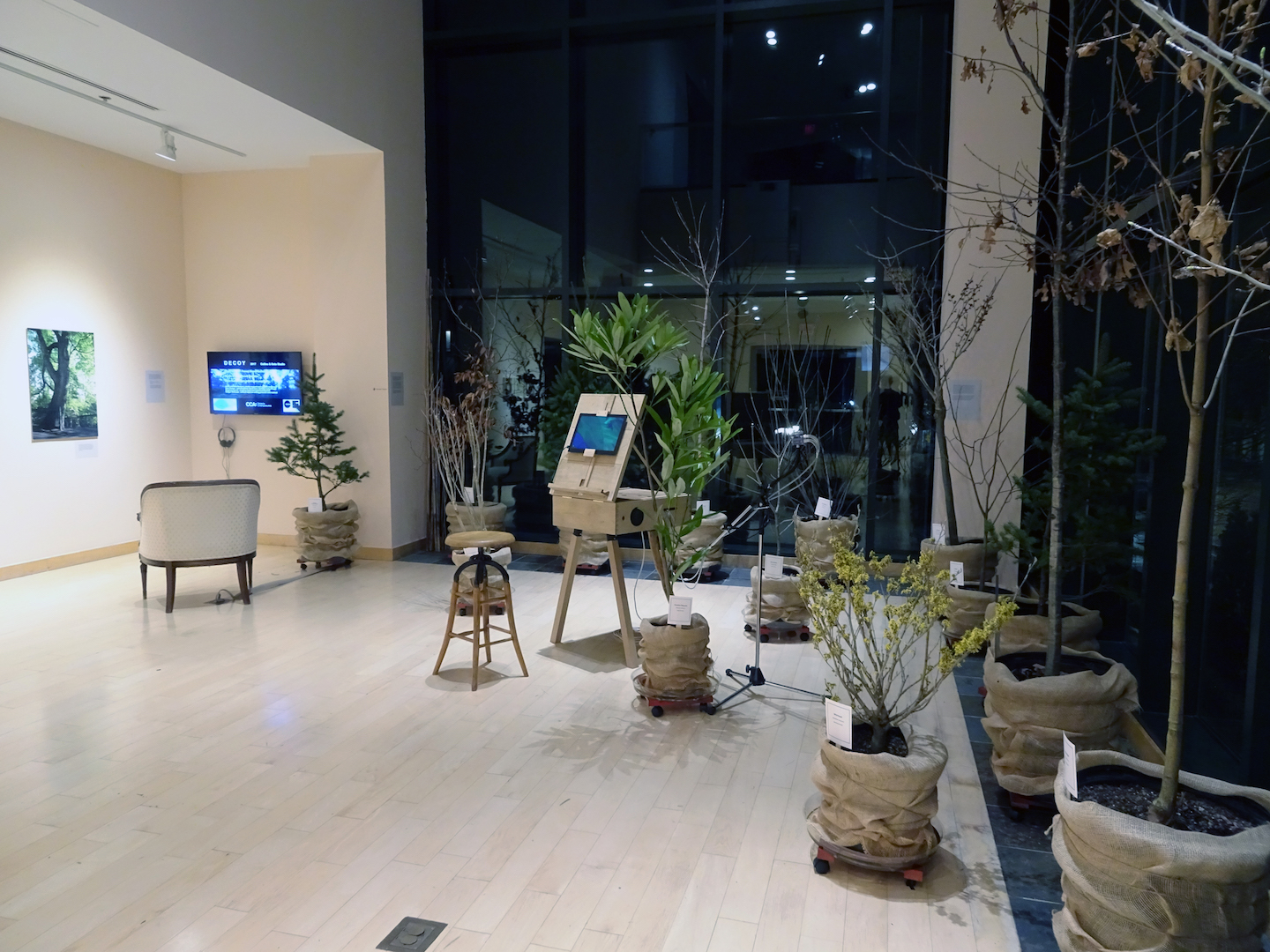
- Turchin Center for the Visual Arts, Boone, North Carolina2019. PLEIN AIR | The Southern Appalachian Forest, curated by Mary Anne Redding: sixteen trees from local nurseries, from American beech to witch hazel.
3
Research Strategies, Methodologies & Artistic Approaches
3.1 The instrument
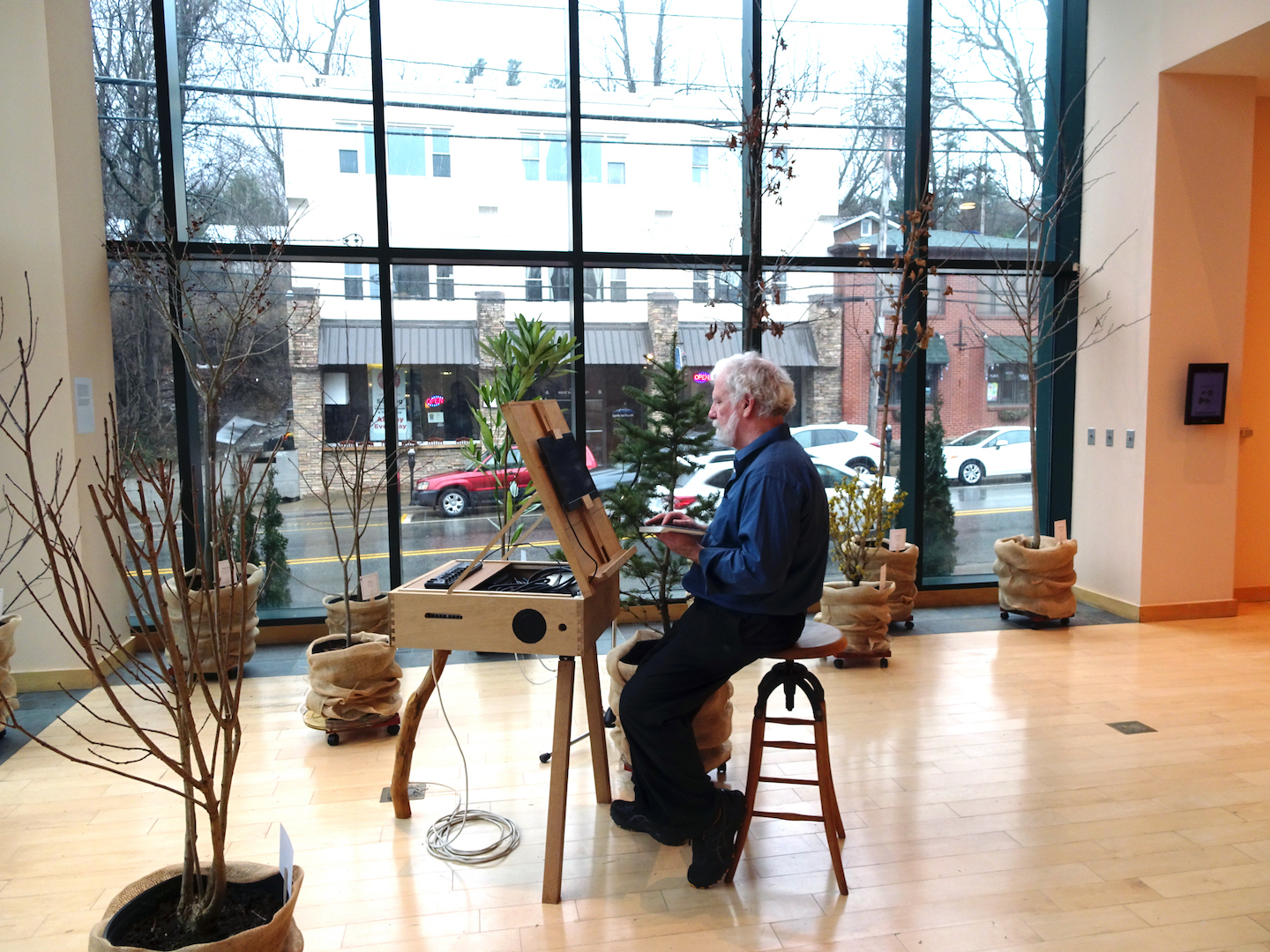
PLEIN AIR is an easel-based system of connected elements. A tree leaf is held in a chamber on a stand. Air is drawn in through a port on the back of the easel, measured by a bank of sensors, pumped through the leaf chamber and measured again. A fall in carbon dioxide indicates photosynthesis; a rise in humidity indicates transpiration; a light sensor sits on the chamber. The measurements follow the stomata, the thousands of small pores on a leaf, opening and closing with the needs of the plant and the changing light and weather.
Humans affect this shared atmosphere by breathing and by industry, transport and development, yet have little sensitivity to carbon dioxide. With sensors we can perceive a tree as it reacts. The research is focused on creating conditions where attention, guided by aesthetic experience, enables the potential for empathic exchange in real time.
3.2 Four phases
- 2008–09, the first iteration. Conceived as Reiko began her doctoral research at Robert Gordon University and Tim held a research grant from the University of Wolverhampton. Table-top equipment, a separate sound system, experiments at Headlands, then refinement at the Crop Technology Unit.
- 2009–10, a field instrument. A laptop-based, battery-run folding sound-easel, hand-made in hardwood. Outdoors in Aberdeen people were curious but rarely stayed: sympathetic engagement, in Stein’s sense, rather than the imaginative projection we hoped for. In the Peacock gallery greenhouse, without us there to explain, visitors sat and listened. The piano voice was clear but dominant; the woodwind gentler but ambiguous.
- 2011–13, the sound. Michael Baldock and Clare Cullen built a sampled, data-driven rhythm track: beautiful, but it hid the tree. Chris Malcolm then built custom synthesisers and resonators that the tree could play, beginning with a data-driven bass line that rises and falls with photosynthesis and transpiration.
- 2015–17, the final instrument. A new light sensor and sound system for Cologne; then, with Creative Scotland funding, engineer Dave Russ and Chris Malcolm upgraded the sensors and software for the Kibble Palace. The recordings became the LP, produced with Georg Dietzler.
Planned as a lightweight sculpture with a laptop, PLEIN AIR became a robust musical instrument that needed mains power. The practice moved from a dynamic outdoor setting to a stable indoor one, to achieve the clarity needed for an empathic practice with trees.
3.3 What people did
In Cologne the audience of musicians and composers listened longer and more carefully than a typical visual-arts audience, and asked whether anyone had tried to notate the ever-evolving composition. In the Kibble Palace the glasshouse made changes in light and temperature clearly audible. We announced each day which tree was “playing”; people came back, some with friends and family, and asked to hear the same tree again.
4
Conclusions
We return to our key question: can artwork contribute to changing the perception of a tree from a “thing” to a “being” of value? The responses are more cultural and subjective than scientific. Science contributes to our understanding of what a set of things are in form and function; art focuses attention on the individual qualities that set people, places and things apart.
The tree is commonly understood as property, as a resource and as a non-sentient thing. PLEIN AIR sits between ourselves and the individual being of one leaf, one tree, and lets us hear its otherwise silent breathing. It is a simple instrument for a tree to play. Does our sense of moral duty change as we listen?
Art is not an arbitrary cultural complement to science but rather, stands in critical tension to it.
Theodor W. Adorno, Aesthetic Theory (1997, p. 231)
Working in the realm of imagination and metaphor, the work offers a small challenge to the instrumental relationships we have to more-than-human life. The epiphany is to art, as discovery is to science.
Bibliography
Reading & references
By Collins & Goto
- Collins, T. and Goto Collins, R. (2019) PLEIN AIR | The Breath of Trees. Exhibition catalogue, with essays by Mary Anne Redding, Wallace Heim, Emily Brady and Georg Dietzler. Glasgow: Collins & Goto Studio. PDF
- Collins, T., Goto Collins, R., Malcolm, C. and Dietzler, G. (2019) PLEIN AIR | Silva Datum Musica. Vinyl LP. Frankfurt: Gruenrekorder. LP insert (PDF)
- Goto Collins, R. and Collins, T. (2017) “Imagination and Empathy: Artists with Trees.” In Bastian, M., Jones, O., Moore, N. and Roe, E. (eds) Participatory Research in More-than-Human Worlds. Abingdon: Routledge.
- Goto Collins, R. and Collins, T. (2012) “Art and Living Things: The Ethical, Aesthetic Impulse.” In Brady, E. and Phemister, P. (eds) Human-Environment Relations. Dordrecht: Springer. doi:10.1007/978-94-007-2825-7_10
- Goto Collins, R. (2012) Ecology and Environmental Art in Public Place: Talking Tree. PhD thesis, Robert Gordon University. PDF
Reading
- Adorno, T. W. (1997) Aesthetic Theory. Trans. R. Hullot-Kentor. Minneapolis: University of Minnesota Press.
- Chamovitz, D. (2012) What a Plant Knows: A Field Guide to the Senses. Melbourne and London: Scribe.
- Firn, R. (2004) “Plant Intelligence: an Alternative Point of View.” Annals of Botany 93(4), 345–351.
- Lakoff, G. and Johnson, M. (1980) Metaphors We Live By. Chicago: University of Chicago Press.
- Stein, E. ([1917] 2002) On the Problem of Empathy. Trans. W. Stein. Washington, DC: ICS Publications.
- Trewavas, A. (2005) “Green Plants as Intelligent Organisms.” Trends in Plant Science 10(9), 413–419.
Also
Plein Air elsewhere
- Works: PLEIN AIR | Southern Appalachian Forest (2019) · Plein Air in “Resounding Change”, Western Carolina University (2019) · CO2 Edenburgh: Can Art Change the Climate? (Eden 3, 2013)
- 2013: Eden3: Trees are the Language of Landscape · the new programme by Chris Malcolm · Tent lecture
- 2015: exhibition and performance in Cologne
- 2019: the Southern Appalachian Forest · The Breath of Trees · Silva Datum Musica reviewed by Robert Barry in The Wire 429
- Next: the instrument led to HAKOTO (2022–), a portable body instrument for working with trees and bogs outdoors.
More tree recordings
Credits
People
Collins & Goto Studio, Tim Collins and Reiko Goto Collins. Sound programming: Chris Malcolm. Producer: Georg Dietzler. Engineering: Dave Russ (Campsie Creative).
Phase one: Prof Carola Boehm, Dr Mat Dalgleish, Prof Anne Douglas, Prof Trevor Hocking, Dr Stephen Hunt (Qubit Systems). Phase two: Michael Baldock, Clare Cullen, Pete Richards. Phases three and four: Nicola Chambury, Georg Dietzler, Noel Hefele, Chris Malcolm, Dave Russ.
Final development, exhibition planning and the recordings were funded by Creative Scotland (2016–17); final production at Glasgow Sculpture Studios.