A Proposal: Der WasserWeg – or The Water Way Riesa-Groβenhain
Collins and Goto
We respond to what is literally an agri-culture, a culture of the land. We came to this place from Pittsburgh Pennsylvania which was until recently an industrial culture. Upon arrival, we realized that we must have humility here; we must ask, not speak, we must give, not take. The people of Riesa-Groβenhain know the land, their life has occurred on the land over centuries. We believe that we can learn about the land by looking at the water. We would like to meet people that use and care about water. We would like to walk and think with them. We would like to use the common languages of experience and science to go to the waters edge and ask the water to speak – to tell us a story. The story of water in this place will be complicated. It will be a story of people that love this place, complicated by economies, technologies and land politics. The water tells its story with honesty, it tells us what we do on the land when it is good and it also tells us when what we do on the land is not good.
In more scientific terms, we are interested in aquatic ecological systems and what they reveal – the potential for life, the diversity of life, and impact upon life. By extension we are also interested in the attendant riparian systems and upland terrestrial systems and land uses that affect water.
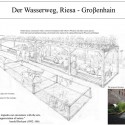
We propose a two part program for Riesa- Groβenhain; The Wasserweg Study, and The Wasserweg Dialogues. We will work closely with local German planners to initiate the Wasserweg Study. We will identify a water quality testing strategy. They will then arrive in Riesa-Groβenhain with a research associate prepared to study the streams and train local youth groups to participate in field studies and the graphic representation of streams and data.
To prepare for the Wasser Weg Dialogues, we propose to work with the staff of the Groβenhain Kultur Zentrum to transform the lower area into a symbol and setting for ongoing discussions about water quality. This project extends the current agricultural planting scheme.