A critical forest art practice: art with the Black Wood of Rannoch, rather than in it
On this page
Introduction
Could the arts and humanities renew a cultural relationship with an ancient forest?
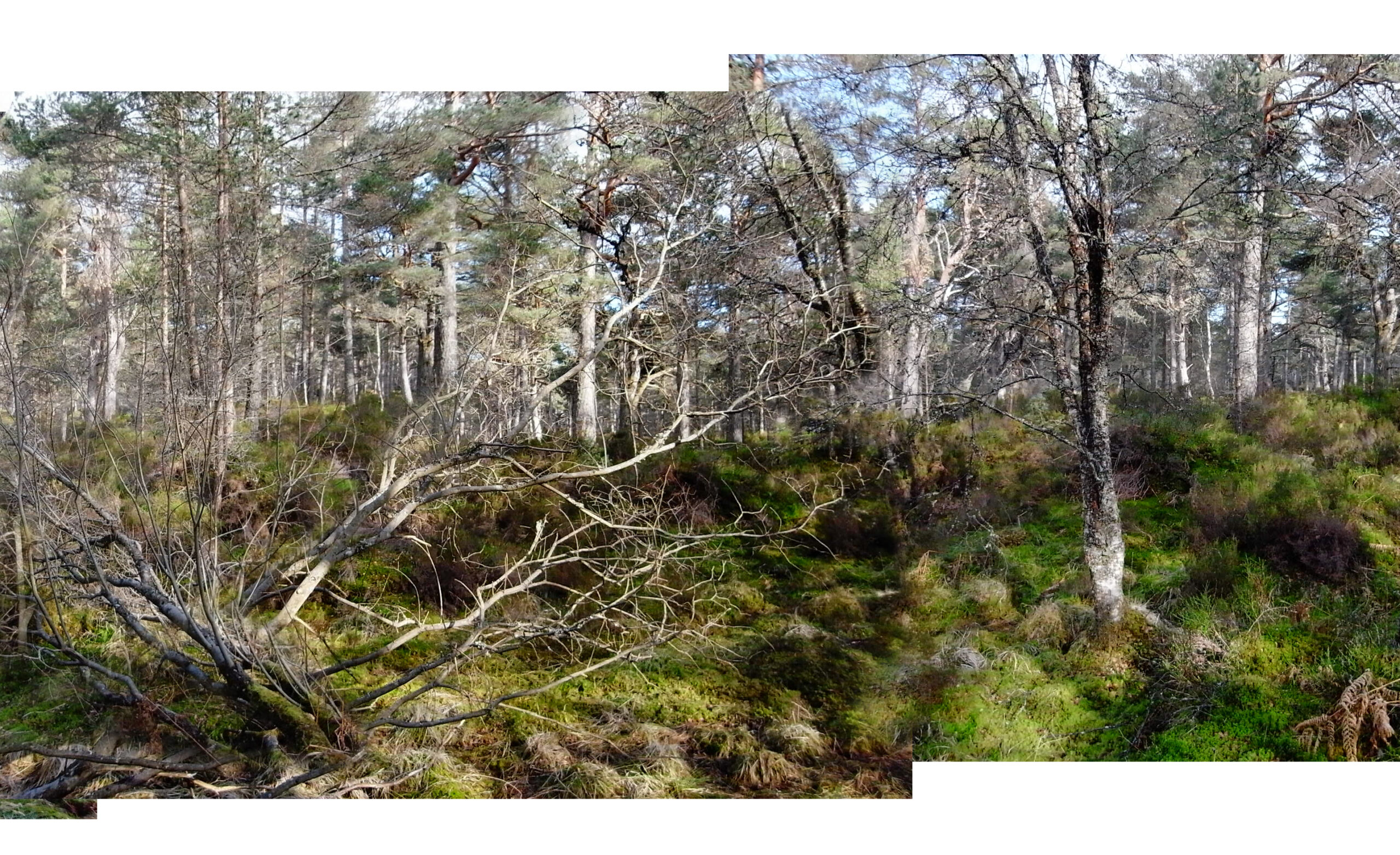
The Black Wood of Rannoch is one of the largest, oldest and most southern remnants of the ancient Caledonian pine forests of Scotland: one of only six with a thousand hectares or more, known for its “granny pines”, 200 to 300 years old, with broad horizontal branches.
It is ecologically robust but culturally impoverished. Its management has been defined almost entirely by biodiversity conservation since the 1970s, and the cultural content and public interest one would expect around a historically important forest are largely missing. Between 2012 and 2017 we worked with social scientist David Edwards of Forest Research, the Rannoch community and the agencies that care for the wood to understand how that happened, and to start recovering what had been lost.
1
Contexts & Themes
We set out to:
- establish a model for art with forests rather than in forests: art as an ephemeral forest interface in a rural setting, and as a correspondent image, idea or artefact in an urban one;
- experiment with empathic exchange between people and trees, and consider how the forest embodies culture and how culture embodies the forest;
- consider how art might contribute to the wellbeing of a tree or forest community in an age of environmental change.
Lineage
The work sits in a line of art with trees and forests: Alan Sonfist’s Time Landscape (1978) in New York, Herman de Vries’s Meadow, Joseph Beuys’s 7000 Oaks in Kassel, and above all Helen Mayer Harrison and Newton Harrison’s Serpentine Lattice (1993), a dialogue between science and culture in the redwood rainforest. Closer to home, Shelley Sacks’s University of the Trees and Alec Finlay and Gerry Loose’s Seeding the John Muir Way share a sense of recovering cultural ecologies through art practice.
A history of conflict
The aesthetic form so admired in the Black Wood today partly embodies the conflicted history of the Rannoch valley. The Robertson estate was forfeited to the Crown after the Jacobite risings, and the wood was felled heavily. The Highland Clearances replaced half the population with sheep. Later the wood was fenced as a deer forest, and cut again for the railway and two world wars. Generations of grazing opened the canopy, so the pines grew outwards as well as up. The Forestry Commission acquired it in 1947; since 1975 it has been managed for conservation, with the public welcome only where there is no conflict with that aim.
2
Sites & Locations
Residencies began in the Black Wood and with its community of interests in Rannoch. They continued with the curators at Perth Museum and Art Gallery and the Forestry Commission archives in the Tay Forest District, and ended at Forest Research, with time set aside for reflection with a social scientist.
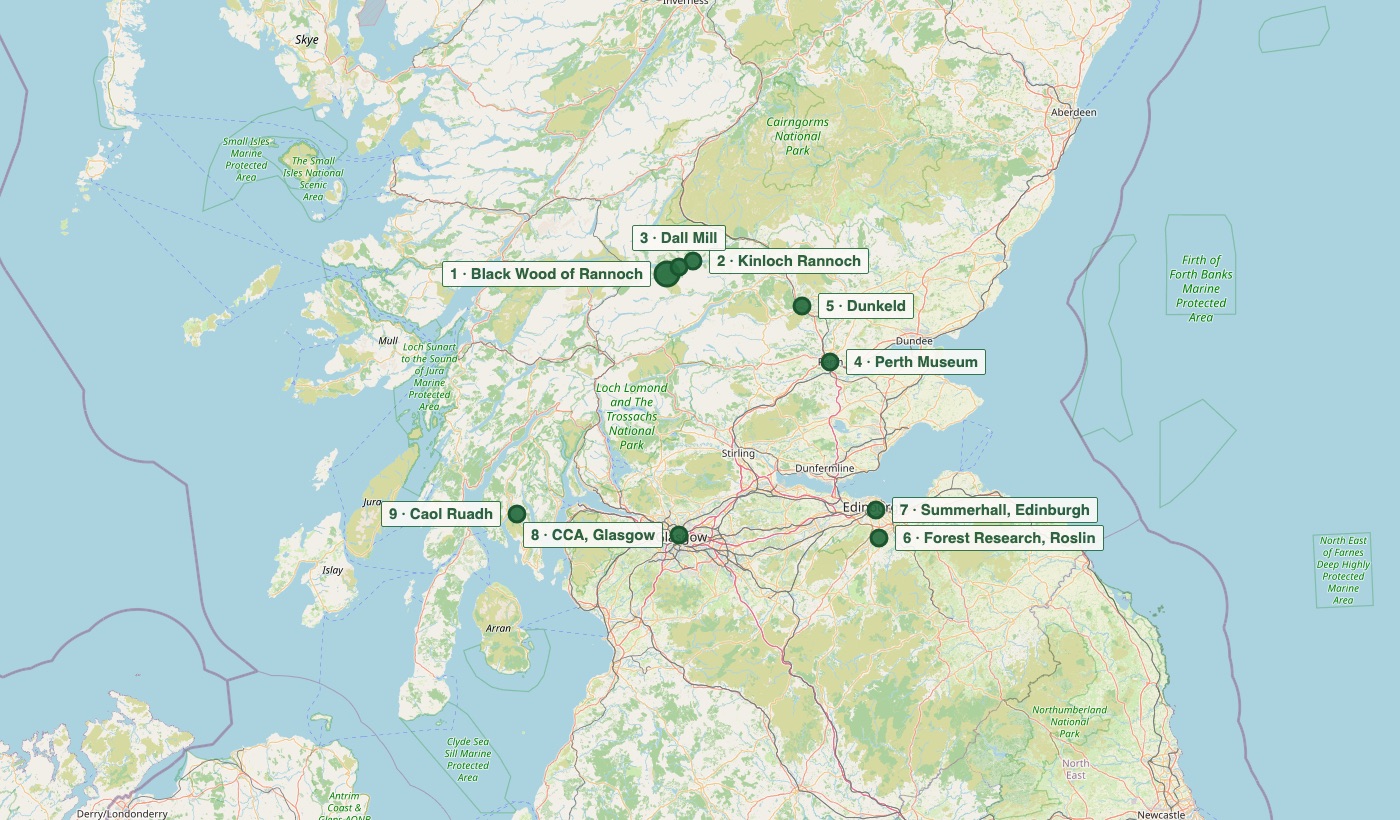
- 1 · The Black Wood of Rannoch2012–17. Repeated visits through the seasons and the deer rut: video, time-lapse of regeneration sites, walking the old trails.
- 2 · Kinloch RannochNovember 2013. The two-day Future Forest workshop with thirty participants.
- 3 · Dall Mill, RannochAugust 2015. The Breadalbane Deliberation: a week’s exhibition and workshop around a 3 × 3 metre map of the region, at the home of Bob and Annie Benson.
- 4 · Perth Museum and Art Gallery2013. The Forest is Moving / Tha a’ Choille a’ Gluasad, and a search of the collections for the forest’s cultural record.
- 5 · DunkeldThe Forestry Commission library and archives of the Tay Forest District.
- 6 · Forest Research, RoslinReflection and writing with David Edwards.
- 7 · Summerhall, EdinburghSpring 2015. Sylva Caledonia, with Gerry Loose, Morven Gregor and Chris Fremantle, for the Edinburgh International Science Festival.
- 8 · CCA, GlasgowFebruary 2017. A Caledonian Decoy, Intermedia Gallery.
- 9 · Caol Ruadh Sculpture ParkFIADH, the deer-exclosure sculpture, after Summerhall.
3
Research Strategies, Methodologies & Artistic Approaches
An inductive method of creative inquiry: archival research and reading, repeated time in the forest, video, time-lapse photography and recorded meetings, balanced with time in the studio to reflect on the material and assemble images and text.
3.1 The forest is moving
Our first idea was to map the old trails through the forest and share them with the public. The Forestry Commission made clear that anything increasing public awareness or use of the wood would be discouraged. That tension became the subject of The Forest is Moving / Tha a’ Choille a’ Gluasad (Perth Museum, 2013): a two-frame video panning east and west while Gaelic place names appear and fade, followed by their English translations. It ends with a question:
What might it take to deliver a future Black Wood that takes more than a day to walk through, and repays time and attention with special experience and knowledge that fires the cultural imagination for generations to come?
The Forest is Moving, 2013
3.2 Looking for the cultural record
The management plan names a set of canals as the only archaeology in the forest. National records list 46 potential heritage sites in the Black Wood, and the regional historic environment record lists another 25. Perth Museum holds a few insect and pressed-plant specimens, but no artworks, photographs or historic artefacts. The Gaelic place names on the Ordnance Survey maps, translated locally for the project, hint at a heritage that could still be recovered.
3.3 The Future Forest workshop
A deliberative process of social learning, held over two days in Rannoch: artists, humanities scholars, agency scientists, charities and local residents, thirty in all. Local Forestry Commission staff told the forest’s story. Speakers covered environmental aesthetics, Gaelic language and visual culture, walking, and art in a public forest. Two working groups, on community and on planning and management, worked with the maps and plans to imagine the future forest. Key recommendations:
- further planning with the “forest community”;
- a Caledonian Forest Way: a long-distance trail of language and literature linking forests and valleys;
- a combined residency programme in the village for ecology, arts and humanities practitioners.
3.4 Cultural decoys
In the studio the work became a series of “cultural decoys”: objects, images and films that lure the viewer into the entanglement of nature and culture in a Highland forest. They include an old deerstalker’s ladder found in the wood, a bitless bridle of birch twigs and horsehair from Gaelic folklore, and FIADH (Gaelic for deer, and for wildness), a model for a deer exclosure that spells a word. They were shown together in A Caledonian Decoy at the CCA, Glasgow, in 2017.


4
Conclusions
We are with the ecologists in spirit and in ethical intent to serve the Black Wood, but we are not convinced that human interest can be withdrawn, or that it should be. The forest needs practical human attention within and beyond its boundaries. It needs a congregation at its heart that represents more than the “druids” of ecology, conservation and forestry. A diverse social and cultural ecology is needed to express a forest’s full value and meaning. What was once a resource became a biodiversity refuge; its evolving intrinsic value suggests new meaning, representation and advocacy.
…the trees of the forest are things not only imaginatively constituted by human beings but things which constitute human beings themselves…
Martyn Hudson, on John Berger (2000)
The workshop and the interest in it suggest the arts and humanities do have something to contribute to how Caledonian forests are cared for, and why a wider forest community in Scotland matters.
Bibliography
Reading & references
By Collins & Goto, with David Edwards
- Goto Collins, R. and Collins, T. (2018) “The Black Wood: Relations, Empathy and a Feeling of Oneness in Caledonian Pine Forests.” In Bergmann, S. and Clingerman, F. (eds) Arts, Religion, and the Environment. Leiden: Brill. doi:10.1163/9789004358980_008
- Collins, T., Goto, R. and Edwards, D. (2017) “A critical forest art practice: the Black Wood of Rannoch.” Landscape Research 43(2). doi:10.1080/01426397.2017.1318119
- Edwards, D., Collins, T. and Goto, R. (2016) “An arts-led dialogue to elicit shared, plural and cultural values of ecosystems.” Ecosystem Services 21, 319–328. doi:10.1016/j.ecoser.2016.09.018
- Edwards, D., Collins, T. and Goto, R. (2016) “Does the Conservation Status of a Caledonian Forest also Indicate Cultural Ecosystem Value?” In Biocultural Diversity in Europe. Springer. doi:10.1007/978-3-319-26315-1_20
- Collins, T. and Goto Collins, R. (2016) “Defining a Practice: With Reflection on Sylva Caledonia.” In Brady, J. (ed.) Elemental: An Arts and Ecology Reader. Gaia Project Press. PDF
- Collins, T., Goto Collins, R. and Edwards, D. (2015) Future Forest: The Black Wood, Rannoch, Scotland. Landscape Research Group and Forest Research. PDF
- Collins, T., Goto Collins, R. and Edwards, D. (2014) “A Case Study: Forest Futures, Kinloch Rannoch.” In UK National Ecosystem Assessment Follow-on. UNEP-WCMC. PDF
- Collins, T. and Goto, R. (2017) A Caledonian Decoy. Exhibition catalogue, CCA Glasgow. PDF
- Sylva Caledonia (2015). Exhibition catalogue, Summerhall. PDF
Reading
- Hudson, M. (2000) “The clerk of the foresters records: John Berger, the dead and the writing of history.” Rethinking History 4, 261–279.
- Ingold, T. (2011) Being Alive: Essays on Movement, Knowledge and Description. Abingdon: Routledge.
- Irwin, R. (1985) Being and Circumstance: Notes Towards a Conditional Art. Culver City, CA: Lapis Press.
- Kester, G. (2004) Conversation Pieces: Community and Communication in Modern Art. Berkeley: University of California Press.
- Peterken, G. F. and Stace, H. (1987) “Stand structure and development of the Black Wood of Rannoch.” Scottish Forestry 41, 29–44.
- Steven, H. M. and Carlisle, A. (1959) The Native Pinewoods of Scotland. Edinburgh: Oliver and Boyd.
The full reference list is in the Landscape Research article.
Also
Works & writing
- Works: Decoy · FIADH · The Ladder in the Wood · Taod Gaoisdei and An Dorchadas · Lanolin: Can you see the forests of Scotland?
- Exhibitions and events: Sylva Caledonia at Summerhall (2015) · The Breadalbane Deliberation (2015) · A Critical Forest Art Practice (2017)
- Review: Minty Donald on A Caledonian Decoy
- Before and after: the tree work of Eden 3: Plein Air; the bogs of Lough Boora and HAKOTO.
Credits
People
Collins & Goto Studio, Tim Collins and Reiko Goto Collins, with David Edwards (Social and Economic Research Group, Forest Research, Roslin). Studio associate Sara Ocklind; Gerry Loose, Morven Gregor and Chris Fremantle (Sylva Caledonia); Paul Tabbush (Landscape Research Group); Bob and Annie Benson (Dall Mill); and the Rannoch community, Forestry Commission Scotland staff and workshop participants.
Primary funding from Creative Scotland (Imagining Natural Scotland), with match funding and support from the Landscape Research Group and Forestry Commission Scotland, and in-kind support from the Perth and Kinross Countryside Trust, Perth Museum and Art Gallery and Forest Research.