Why Giant Sea Bass?
When I first arrived in Manhattan Beach, Cultural Arts Manager Howard Spector loaned each of the artists a book called Manhattan Beach 90266, a pictorial history by the Manhattan Beach Historical Society. The most amazing image that I saw in this book was a photo of “a giant sea bass weighing 351 pound caught by C. C. Campus at the Manhattan Beach Pier on May 15 1922.” I immediately decided to research the biology and history of this giant fish and see if I couldn’t reintroduce the story of the fish and its attendant mythology back to the community of Manhattan Beach. I was particularly excited about the local aquarium, the Roundhouse Marine Studies Lab, as a site because of its proximity to the ocean and its location on the very pier many of the fish were caught on in the past. Initial conversations with marine biologist Jose Bacallao suggested our collaboration was of mutual academic interest and would prove to be very exciting.
The human experience of the ocean has changed drastically over the last century. Where once giant fish were plentiful, they are endangered. Where the ocean was once an endless site of opportunity and wonder, it is threatened by human excess. There are different values and opportunities at work in a community when a fisherman might be able to catch a 600-pound giant sea bass off the pier during a week-end. What a mysterious and exciting moment those experiences must have been, what dreams these stories and experiences must have created! The ocean was a much more lively place when she revealed her wonders to the people of the local community. Today the giant sea bass is an almost mythical image from another time. Industrial culture, its attendant technology and greed have all taken a toll on the giant sea bass. Today we are only likely to see them in an aquarium. The giant sea bass is a part of Manhattan Beach history, but more importantly it is part of the larger ocean environment. How can we celebrate the future of the large fish rather than regret its loss?
According to articles in California’s Living Marine Resources And Their Utilization, giant sea bass are the largest resident marine bony fish in California. They grow to seven feet five inches in length. Fish up to 563 pounds have been recorded from the sport fishery. Fish up to 75 years old have been caught (A 435-pound specimen. The age of the 563 pound fish was not determined, but may have been 90 to 100 years old). A giant sea bass could live for 75 years or longer, an lifespan equivalent to that of a human being!. Through this exhibit I hope that people will think about the sea and marine life now and and in the future, as well as remember those wonderful memories when man-sized fish appeared on the piers. I believe that jogging the cultural memory of the giant sea bass, and the sight of the juvenile of the species will contribute to a productive sense of ocean stewarding.
Elements of the exhibition

The project consists of three major elements:
- A very large young fish in the aquarium at the Roundhouse Marine Studies Lab, at the end of the Manhattan Beach Pier.
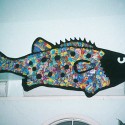
- A childrens art project created during May 1997. We worked for a week to create the individual scales of for a model of an adult giant sea bass.
- A chronology of Manhattan Beach interspersed with information about the giant sea bass fishery.
- History of the giant sea bass fishery.(California’s Living Marine Resources And Their Utilization.)
- Information about the larger natural context of the Manhattan Beach environment provided by the Roundhouse Staff.