Glasgow-based environmental art practice of Tim Collins and Reiko Goto Collins, exploring empathy, ecological change and the cultural meaning of place
On this page
In our words
When we are asked about what we do and why we do it, we seek out opportunities that challenge our subjective experience and understanding of the world around us. In our pursuit of experience informed by readings and conversations we discover/re discover how we understand people, places, and things; the work can be described as social – ecological practice. We seek out new experience and understanding that challenges and changes meaning. What we care about and value changes over time, as we practice a sort of being in a place. Or being in amongst other beings; inter relationships with living entities, like boglands. Artwork emerges as a critical, creative reflection upon experiences that are unique and true.
The studio
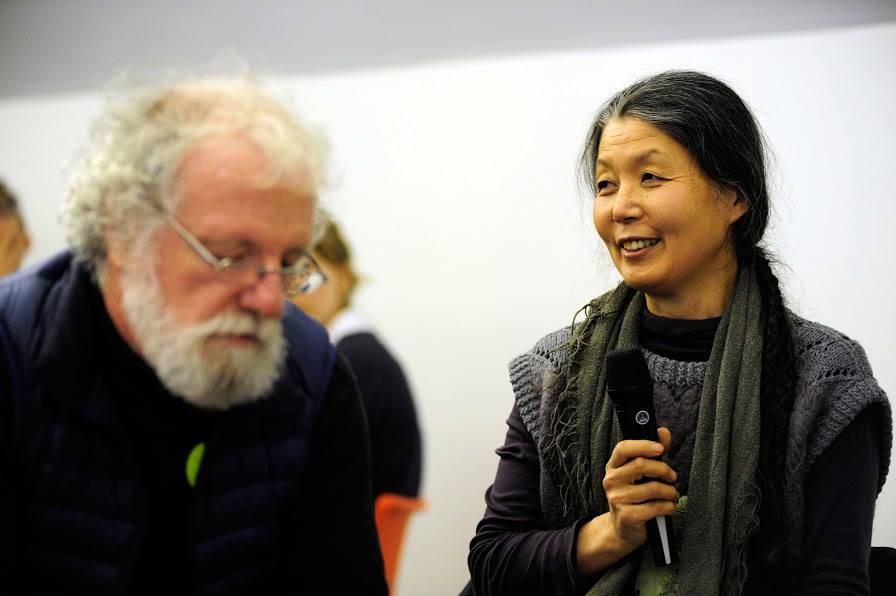
Collins & Goto Studio is the practice of environmental artists and researchers Tim Collins and Reiko Goto Collins. They met at the San Francisco Art Institute in 1985, have worked separately and together ever since, and are now based at Glasgow Sculpture Studios in Scotland.
Their long-term, place-based projects bring together artworks, research, writing and public dialogue, often with scientists, planners, musicians, philosophers and local communities. They explore how art can open ways of perceiving and valuing the living world. Empathy informs their practice through sustained attention, shared experience and imaginative engagement with lives different from their own.
Their methods include deep mapping, which explores the interwoven ecological and cultural histories of a place, and arts-led dialogue, through which people examine and develop their understanding of a landscape.
In Pittsburgh, they worked with Bob Bingham and John Stephen on Nine Mile Run (1997–2000), helping reshape public thinking about a slag-filled stream valley. They subsequently directed 3 Rivers 2nd Nature (2000–2005), a study of the rivers and waterfronts of Allegheny County. Both projects were based at Carnegie Mellon University’s STUDIO for Creative Inquiry.
In Scotland, their work includes Future Forest and The Caledonian Decoy, exploring the Black Wood of Rannoch, and Plein Air, a sculptural instrument that makes a tree’s photosynthesis and transpiration audible. Their deep mapping at Lough Boora considered the cultural meaning of Ireland’s cutaway peatlands. HAKOTO, an instrument designed primarily to work with trees, was subsequently applied to peatlands during a year-long residency in Ireland.
Their current project, Horse | Tree | Earth, explores Glasgow’s history of equine labour alongside questions of restoration and renewal. A horse-and-cart performance will carry trees, tools and soil through the city to Hamiltonhill Claypits Local Nature Reserve for community planting. An exhibition will bring documentation together with archival photographs and participants’ reflections, connecting labour, land, memory and ecological care.
Both are Visiting Research Fellows at Bath Spa University and international associates of RMIT’s Arts and Ecologies Research Network (AEGIS).
Approach
Collins & Goto Studio’s artworking is deeply rooted in a critical engagement with the current environmental crisis. The following text articulates our understanding of art’s role in responding to this unprecedented challenge and outlines the key concepts that guide our practice.
Environmental artworking
Art can be recognized through its similarity to works considered as art in terms of form, content, or concept, or through its unique engagement with meaning and value beyond the practical. Art is a constantly evolving field of human inquiry that resists any finite definition and constantly pushes the boundaries of what is considered art. Artists working in environmental conditions often have a different perspective on the world, reinterpreting history and imagining new futures.
The precipice / climate
The precipice refers to the point where the narratives of a safe and stable environment and unlimited growth through science and industry are being challenged by the global environmental crisis, which cannot be resolved through the technical solutions of modernism. The artist is interested in exploring what this cliff edge represents as a social-ecological construct and how art will change as we move closer to it. The theories and practices of modernism and its postmodern variations are becoming increasingly unstable as the edge of the plateau begins to crumble. Possible responses to this situation include an integration of aesthetics and epistemology (following Cazeaux, 2017) and new forms of artworking that exist in the world alongside other disciplines without relying on their problem-solving frameworks (following Roberts, 2017). Artworking encompasses the inquiry, process, method, and outcome of artistic creation and cannot be defined by one overarching idea that applies to all forms of artworking.
Through our artworking, we aim to foster a deeper understanding of the complex interrelationships between humans and the natural world. We believe that art has the capacity to inspire empathy, provoke critical reflection, and ultimately, contribute to the creation of a more just and sustainable future.
PhD, MFA, BFA
Tim Collins
Tim Collins (Timothy M. Collins) is an environmental artist, researcher and writer, and a principal of Collins & Goto Studio in Glasgow, which he founded with Reiko Goto Collins. He holds a BFA from the University of Rhode Island, an MFA in sculpture from the San Francisco Art Institute and a PhD from the University of Plymouth. His doctoral thesis is Art, Ecology and Planning: Strategic Concepts and Creativity within the Post Industrial Public Realm (2007).
His work asks how art can reshape perceptions of nature and the cultural values informing environmental decisions. Through long-term projects, artworks, writing and public dialogue, he works with scientists, planners, musicians, historians, philosophers and communities. This practice creates opportunities to question established understanding, including the artists’ own, and imagine the future of shared places.
From 1997 to 2005, he was an artist-research fellow, later Distinguished Fellow, at Carnegie Mellon University’s STUDIO for Creative Inquiry, co-directing Nine Mile Run and 3 Rivers 2nd Nature. He subsequently held UK research leadership posts, including Professor of Art, Society and Environment at the University of Wolverhampton, where he founded CADRE.
His work with Reiko includes deep mapping in the Black Wood of Rannoch and at Lough Boora, and the sculptural instruments Plein Air and HAKOTO. HAKOTO was designed primarily for trees; its peatland application developed during a year-long Irish residency.
Their current project, Horse | Tree | Earth, explores labour, land and memory in Glasgow. A horse-and-cart performance, community tree planting and an exhibition will connect equine heritage with ecological restoration and care.
He publishes across art and environmental research and is a Visiting Research Fellow at Bath Spa University and an international associate of RMIT’s Arts and Ecologies Research Network (AEGIS).
Documents and profiles
The thesis explores the potential impact of art on ecology and planning in public spaces. Through a detailed examination of historical and contemporary ideas in public art practice, the author evaluates the effectiveness of art as a tool for shifting perceptions and re-framing concepts in the context of environmental conservation and restoration.
PhD, MFA, BFA
Reiko Goto Collins
Reiko Goto Collins (also published as Reiko Goto) is an environmental artist and researcher, and a principal of Collins & Goto Studio in Glasgow, which she founded with Tim Collins. She holds a BFA from Joshibi University of Art and Design, an MFA from the San Francisco Art Institute and a PhD from Gray’s School of Art, Robert Gordon University (2012). Her doctoral research, Ecology and Environmental Art in Public Place: Talking Tree, examines empathy and relationships between people and trees.
“My artistic subject matter is the life of nature.” Her work approaches empathy through attention, imagination and openness to other beings. Informed by Edith Stein’s phenomenology and biosemiotics, the study of signs and meaning in living systems, she explores how encounters can change human understanding while respecting another being’s difference.
Plein Air makes a living tree’s photosynthesis and transpiration audible. HAKOTO was likewise designed primarily to work with trees; its application to peatlands developed during a year-long Irish residency. Her ongoing work with the horse Darkness explores communication through shared experience, movement and attention to signs.
With Tim Collins, she co-directed Nine Mile Run and 3 Rivers 2nd Nature at Carnegie Mellon University’s STUDIO for Creative Inquiry, where she was a fellow from 1997 to 2005.
Their current project, Horse | Tree | Earth, explores Glasgow’s equine heritage and relationships between people, animals, plants and soil. A horse-and-cart performance and community tree planting will lead to an exhibition connecting historical images of labour with contemporary experiences of restoration, renewal and care.
She is a Visiting Research Fellow at Bath Spa University and an international associate of RMIT’s Arts and Ecologies Research Network (AEGIS).
Documents and profiles
More
- Publications: 59 books, articles, chapters and catalogues, 1991–2025
- Film & Video: films grouped by project, 2010–2024
- Interviews & Conversations, including The Art of Empathy for WEAD Magazine (2022)
- Selected CV: positions, public art and planning, residencies, talks
- Contact