
Art, ecology and community on the rivers of Allegheny County, Pennsylvania
On this page
Introduction
Can artists change the real-world aesthetic conditions of a post-industrial region?
3 Rivers 2nd Nature was a five-year, artist-led study of the meaning, form and function of nature and public space in Allegheny County, the former steel capital of the United States. It worked with scientists and non-profit organisations to build a new level of attention and care for water and nature along the Allegheny, Monongahela and Ohio rivers and the county’s streams.
It grew out of Nine Mile Run, where the focus on realising opportunities rather than “fixing” problems had been tested on a single stream valley. Here the scale was regional: a 730-square-mile county, 90 miles of river (180 miles of riverbank) and up to 2,000 miles of streams. The plan was to treat natural, or green, infrastructure as the subject of artist-led interdisciplinary research and public discourse.
Just as we must carefully plan for and invest in our capital infrastructure, our roads, our bridges and water lines, we must also invest in our environment, our green infrastructure: our forests, our wetlands, our streams and our rivers.
Parris Glendening, quoted in the original proposal
1
Contexts & Themes
Aesthetics
The project drew on environmental aesthetics: Allen Carlson’s scientifically informed aesthetics, and Arnold Berleant’s idea of people, things and places as one field, with implications “not only aesthetic but moral and political as well”. It worked from the premise that human values arise from lived experience and concept-informed perception, so it paired experiences out on the rivers with concepts from new field science and maps.
From the water, the view revealed a striking recovery of nature on the floodplains and steep valley slopes. From the roads, the view was still post-industrial and cut people off from the river. Value and care, the team argued, grow from direct experience.
The public realm
Following Bent Flyvbjerg, who links Habermas’s rational discourse to Foucault’s attention to power, the team understood the public realm as having three essential conditions: conflict, discourse and consensus. For it to work, power has to be contested, discourse invested in, and the creative potential of consensus stretched.
Strategic knowledge
The method, developed at Nine Mile Run, was to disseminate strategic public knowledge, provide an experience where that knowledge could reshape perception, and capture the values that emerged in platforms for discourse. The missing knowledge concerned water quality, forest cover, land use and environmental protection. To fill the gap the team completed eighteen reports over five years.
2
Sites & Locations
- 1 · The three riversThe Allegheny, Monongahela and Ohio within Allegheny County, divided into stretches of about twenty-five miles and studied in turn.
- 2 · The 56 stream mouthsSampled by walking up each streambed to the first riffle pool, above the backwater from the rivers.
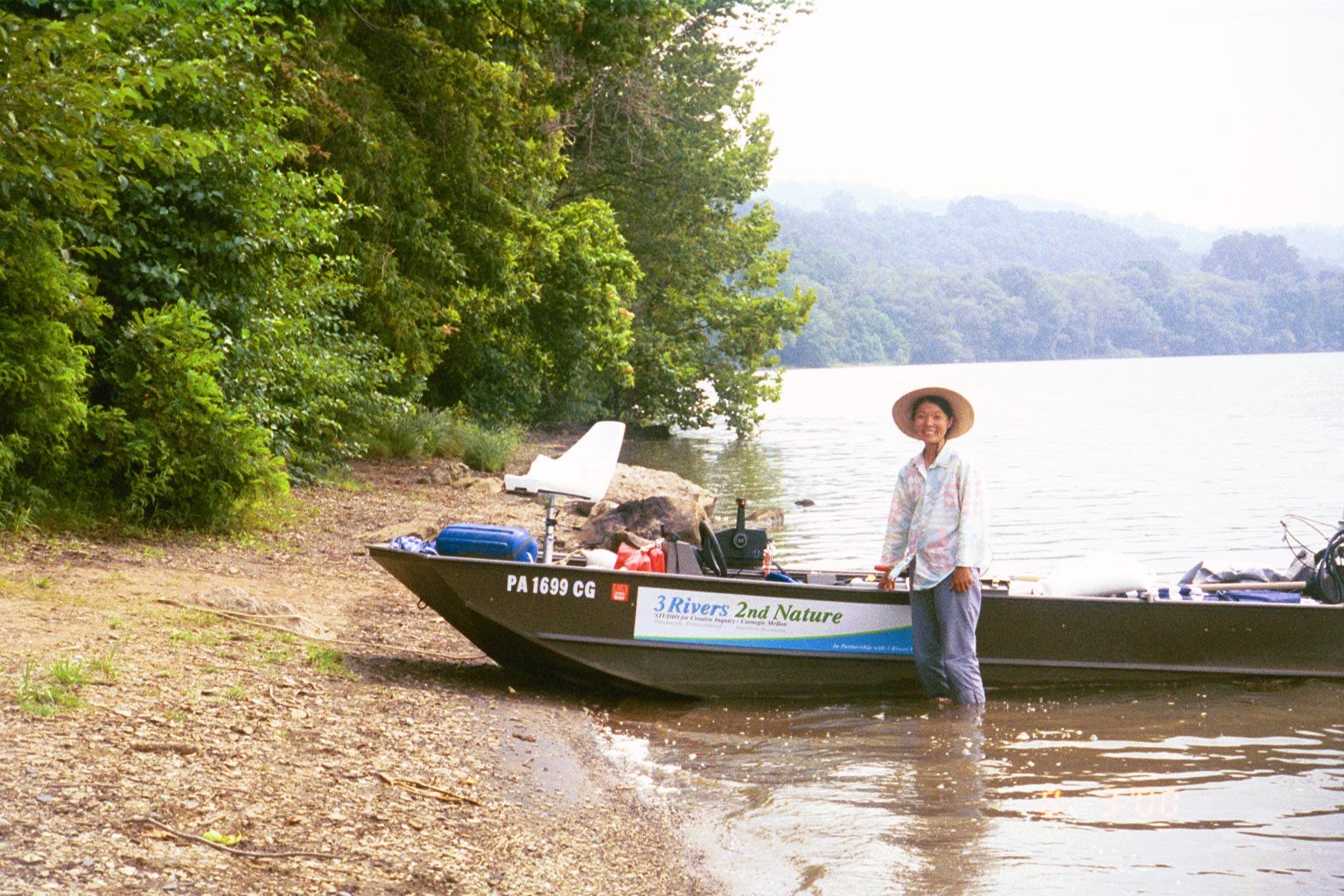
- 3 · The riverbanks200 miles surveyed by boat in 1/10-mile GIS increments, fifty miles each summer for four years, the boat beached wherever the bank or forest changed.
- 4 · The River DialoguesTwo a year, always in a different community, on catamaran water taxis and around drawing tables afterwards.
- 5 · Mount Washington2004–05. The Hillsides Project, which led to the city’s first steep-slope park.
- 6 · Braddock, Homestead and McKeesportMonongahela valley river towns: the Monongahela Conference visits and the Monongahela Residencies, working from a library, a storefront and a municipal office.
- 7 · Miller Gallery, Carnegie MellonAutumn 2005. Groundworks, three floors, fifteen collaborative projects from around the world, with the 2005 Monongahela Conference.
- 8 · STUDIO for Creative InquiryThe project’s base, funded by the Heinz Endowments from 1 January 2000, in partnership with Three Rivers Wet Weather.
3
Research Strategies, Methodologies & Artistic Approaches
The work ran in three strands: water, land and dialogue. Tim Collins directed the project, working on infrastructure, regulation and water. Reiko Goto, as creative director, focused on the experience and representation of the recovering land-based ecosystem and forest cover. A technical advisory board, and later an outreach advisory board of regional advocates, gave the work its own base of scientific and social strength.
3.1 Water
With Three Rivers Wet Weather, the team built a dry-weather and wet-weather database, sampling the rivers and the mouths of all fifty-six streams for physical chemistry, capacity to support life, and pathogens. US Army Corps of Engineers biologists studied stream ecology. The rivers ran clean in dry weather, but many streams did not: some were worse in dry weather than the rivers in wet. These are the streams that run through neighbourhoods and parks, where children play.
The finding should have reshaped the region’s “wet-weather” problem. Instead the science was questioned, ignored or held back by legal oversight. The 3R2N database became the most widely referenced water-quality database in the region, yet neither the state nor the federal government would accept it into public databases. Attorney William Luneburg’s white paper, Where the Three Rivers Converge, analysed why the regulatory system failed and proposed alternatives.
3.2 Land
A team led by Reiko Goto, with botanist Susan Kalisz and geologists Henry Prellwitz and Roman Kyshakevych, recorded forest species, density and plant communities, invasive plants, wetland indicators, and the condition of bank and berm. Where the water work met conflict, the land work became a rallying point. Photographs of forested sites and large trees “elicited a sense of pride and wonder at the resilience of nature”.
In the last two years, planners Jonathan Kline and Kostoula Vallianos applied Richard Forman’s patch-corridor-matrix landscape ecology to the county’s GIS data. They showed, for example, that the economically deprived Monongahela valley held huge swaths of recovering forest but the least parkland per person. With land-use attorney Cyril Fox, this became the final report, Ecology and Recovery: Allegheny County (2006), a guide to preserving, conserving and restoring the county’s remnant forests.
3.3 The Hillsides Project
In 2004 a citizens’ committee on Mount Washington, led by Lynn Squilla and the Mount Washington Community Development Corporation, set out to protect steep forested slopes from rezoning. 3R2N joined Perkins Eastman Architects and the Allegheny Land Trust. The artist-led team made a quantitative case reinforced by law: zoning based on public safety, given landslide-prone soils. The proposal went to City Council in August 2005, and the first steep-slope city park was established that December.
3.4 Dialogue
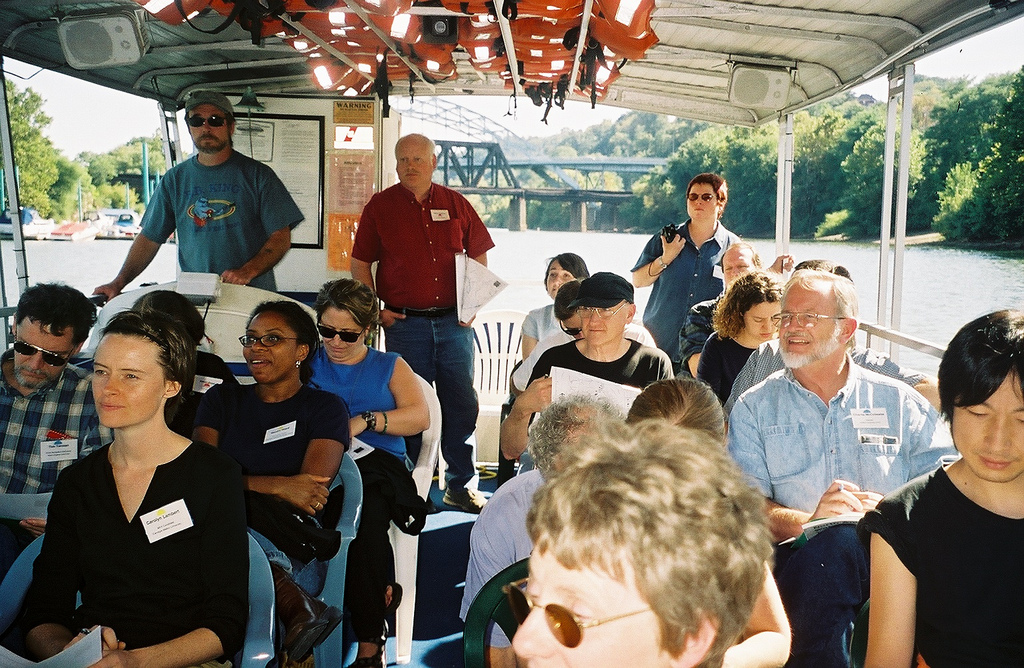
The River Dialogues, co-developed with Three Rivers Wet Weather, were migratory, four-to-six-hour days. An expert seminar was followed by a trip on the rivers by catamaran, a shared meal, and then working tables with a facilitator, a planner, a note-taker and drawers to record opportunities and constraints. The records became a river trail plan, Water Trails, managed by Reiko Goto. Many people returned for all four years.
A parallel series turned to art itself. The 2003 Monongahela Conference gathered twenty artists and theorists to discuss the intent, methods and means of transformative practice. The Monongahela Residencies placed twelve artists in Braddock, Homestead and McKeesport for a month with one task: to initiate change. Each artist from outside the region was paired with a regional practitioner. The project closed with Groundworks (2005), curated by Grant Kester, and a conference with Tom Finkelpearl, Ala Plástica, Ichi Ikeda, the Harrisons, Navjot Altaf and others.
4
Conclusions
Intimate proximity, experience and relationship to rivers, land and natural systems are essential if people are to value them. The problems that constrain natural systems in a city cannot be defined by science alone: while replicable fact is the domain of science, human perception and value are the domains of art and the humanities.
Citizens and activists shared an empathetic insight, even many who opposed the team. The institutions that control regional water policy stayed invested in defensive legal positions, and there was political and economic stasis. Consensus, in hindsight, is achieved only among those willing to commit time to an issue.
The work was put to use. The Allegheny Land Trust and others adopted the ecology report. The county released the GIS database to the public PASDA website two years after the project ended. In 2009 the landscape architect Walter Hood, a Monongahela Conference participant, was brought in to plan a new hillside public space above downtown Pittsburgh.
In my case, I am thinking about small contributions to the emancipation of people, places, and things. In Reiko’s case, she is thinking how one might see oneself in empathetic response to all things… This twinned pursuit of an ideal is the value and the roadmap of this collaborative partnership.
Tim Collins, RACAR (2010)
Bibliography
Reading & references
Project publications and writing
- Collins, T. (2010) “3 Rivers 2nd Nature, 2000–2005: Water, Land & Dialogue.” RACAR XXXV(1), 73–85. doi:10.7202/1066804ar · PDF
- Collins, T., Kline, J., Vallianos, K. and Fox, C. (2006) Ecology and Recovery: Allegheny County. Pittsburgh: STUDIO for Creative Inquiry, Carnegie Mellon University. PDF · Executive summary
- Kester, G. (ed.) (2005) Groundworks: Environmental Collaboration in Contemporary Art. Pittsburgh: Regina Gouger Miller Gallery, Carnegie Mellon University. PDF
- Goto, R. and Collins, T. (eds) (2004) The Allegheny County River Dialogue: Water Trails. Pittsburgh: STUDIO for Creative Inquiry. Online
- Collins, T., Farber, S., Fox, C., Goto, R., Perkins Eastman Architects et al. (2004) An Ecological and Physical Investigation of Pittsburgh’s Hillsides. Report to the City of Pittsburgh.
- Luneburg, W. (2004) “Where the Three Rivers Converge: Unassessed Waters and the Future of EPA’s TMDL Program: A Case Study.” Journal of Law and Commerce 24(1).
- Tarr, J., Muller, T. and Collins, T. (2008) “Pittsburgh’s Three Rivers: From Industrial Infrastructure to Environmental Asset.” In Mauch, C. and Zeller, T. (eds) Rivers in History. Pittsburgh: University of Pittsburgh Press. doi:10.2307/jj.490884.8 · PDF
- More reports, on water trails, clean streams, stream impact and water quality: Rivers Re-valued.
Reading
- Berleant, A. (1992) The Aesthetics of Environment. Philadelphia: Temple University Press.
- Carlson, A. (2000) Aesthetics and the Environment: The Appreciation of Nature, Art and Architecture. London: Routledge.
- Finkelpearl, T. (2000) Dialogues in Public Art. Cambridge, MA: MIT Press.
- Flyvbjerg, B. (1998) “Empowering Civil Society: Habermas, Foucault and the Question of Conflict.” In Douglass, M. and Friedmann, J. (eds) Cities for Citizens. Chichester: Wiley.
- Forman, R. T. T. (1995) Land Mosaics: The Ecology of Landscapes and Regions. Cambridge: Cambridge University Press.
- Meadows, D. H. (1997) “Places to Intervene in a System.” Whole Earth, Winter 1997.
Also
Works & the project site
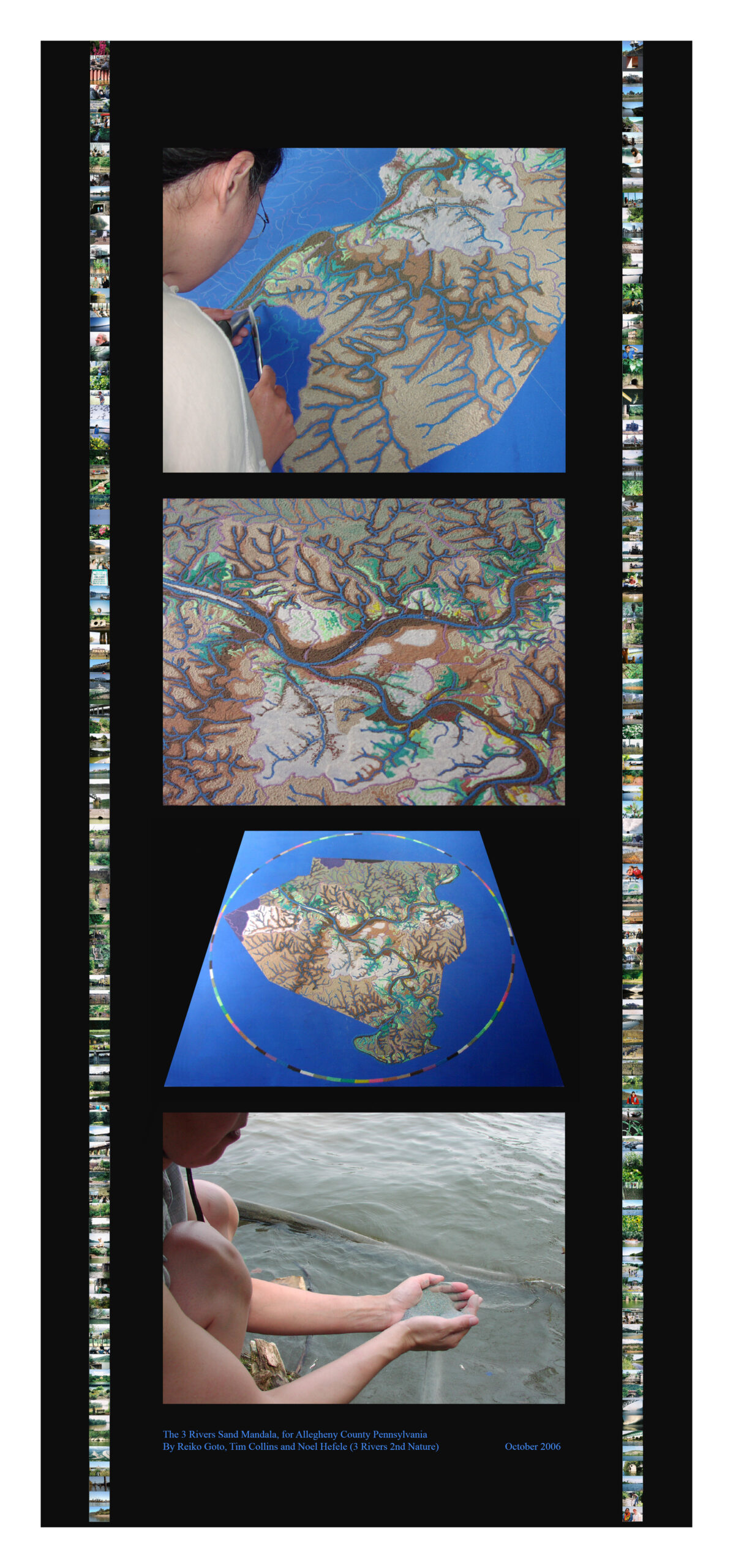
- Works: 3 Rivers 2nd Nature: River Dialogues (2001–2005) · The Monongahela Conferences II, Residencies · The Knotweed Project · 3 Rivers 2nd Nature Mandala
- On the original site: background and methods · river research · reports · river data · the full team
- In the archives: Three Rivers Second Nature Project Records (AIS.2006.19B), University of Pittsburgh Archives & Special Collections · the STUDIO for Creative Inquiry project page
- Before and after: Nine Mile Run (1996–2000); then the move to Scotland and Eden 3: Plein Air.
Credits
People
Tim Collins, project director, and Reiko Goto, creative director, with Noel Hefele (production), Priya Krishna and John Oduroe (mapping and planning), Jonathan Kline (planning), Kostoula Vallianos (conservation planning), Lena Andrews (GIS) and photographer Cliff McGill.
Science, law and history: Susan Kalisz, Henry Prellwitz, Roman Kyshakevych, Jessica Dunn, Kathy Knauer, Mike Koryak, Linda Stafford and Rose Riley; attorneys Cyril Fox and William Luneburg; historian Joel Tarr; with Sue Thompson and Suzy Meyer in the first year. Groundworks curator: Grant Kester.
Partners: Three Rivers Wet Weather, Alcosan and the Allegheny County Health Department, with a technical advisory board of regional scientists, agencies and river organisations. Funded by the Heinz Endowments, with the Pittsburgh Foundation supporting the Monongahela Conference.