Art, bogs and the end of the peat harvest in the Irish Midlands
On this page
Introduction
What role can art play as Ireland’s peat harvest comes to an end?
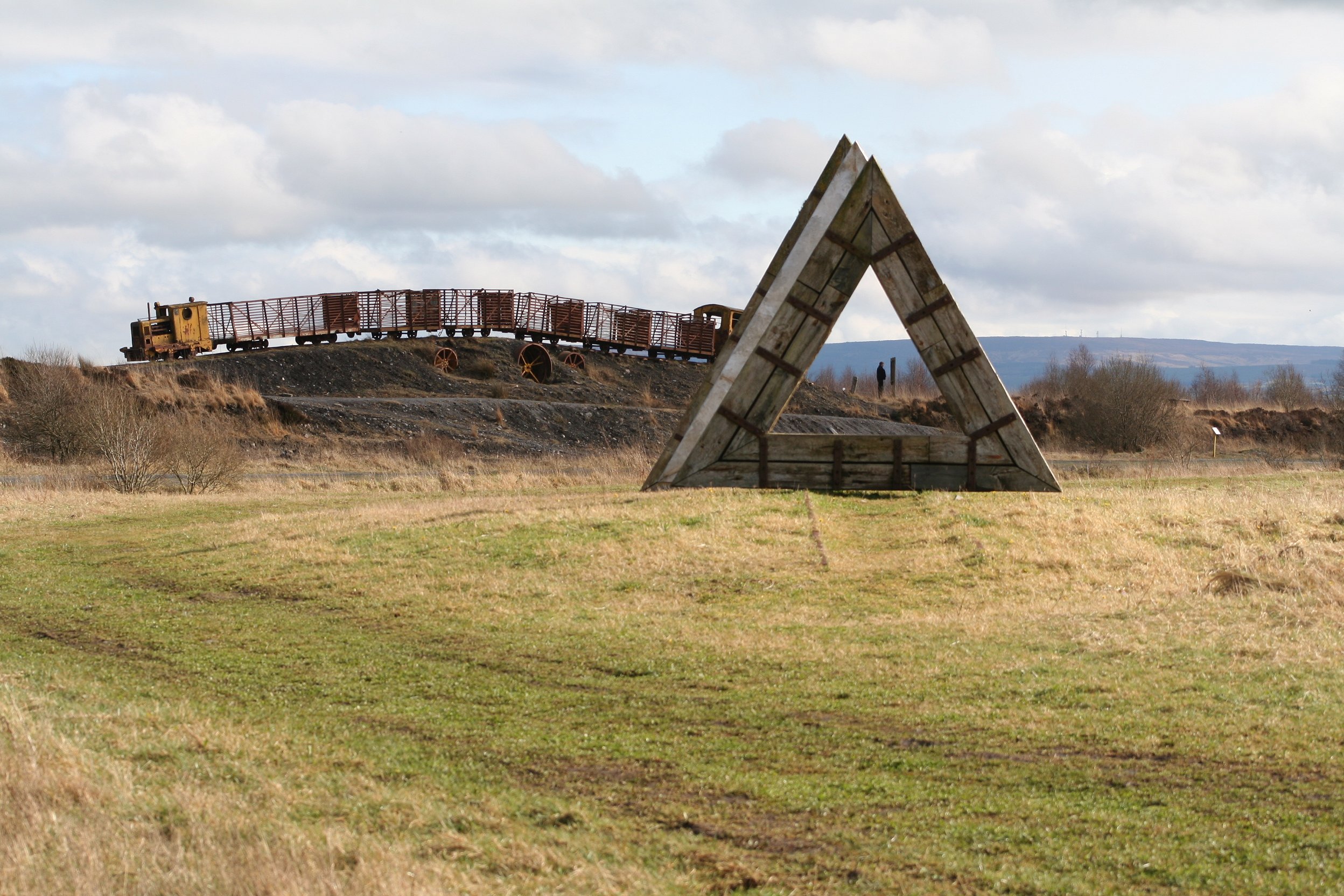
Lough Boora Sculpture Park was made on cutaway bog: land left behind once the last commercially viable peat had been removed. In August 2019 Offaly County Council and Bord na Móna commissioned the studio to propose an artist-led “deep mapping” of the park and the contexts that shape its meaning. The goal was to help agree an exceptional and sustainable artistic vision for its future, and to give artists and scientists considering a residency there a historic, cultural and ecological starting point.
“Deep mapping” is an attempt to become conscious of a place and its many layers of experience, meaning and value. It takes experience, attention to images, reading and writing, a commitment to lived histories and current debate, and walking and talking with a wide mix of people. It means holding several ideas about the same place at the same time, and it is ideally a collective exercise.
Bog lands are not wastelands. Raised bogs are as monumental and significant as redwood forests. Sphagnum is an extraordinary living thing. It is small, fragile but at the same time resilient, never harmful.
Reiko Goto Collins, Deep Mapping (2020)
1
Contexts & Themes
The Irish boglands have moved in less than a hundred years from an everyday condition of Irish life, to wasteland, to fuel resource, to carbon sink and valuable habitat. Each shift brought an upheaval in economy, society and culture, and in people’s relationship to the land.
Historic context
In 1846 the House of Commons debated the reclamation of Ireland’s “waste lands”: over six million acres of it. A century later Bord na Móna industrialised the Midlands peatlands to fuel the nation, with peat-fired power stations such as Ferbane, opened in 1957 and demolished in 1999. Lough Boora and Turraun were the first large raised bogs in Ireland to be cut away until the resource was exhausted. They were also where experiments in reclaiming the land began, first for agriculture and forestry, then for public space, recreation and amenity. In the time that bought, nature regenerated in surprising ways, and a sense of an emergent Irish wilderness took hold.
Sculpture and the parklands
Between 2002 and 2010 curator Kevin O’Dwyer, working with Bord na Móna and the Lough Boora Parklands Group, ran an ambitious programme of collaborative art, engineering and material reuse. Artists were embedded with the Bord na Móna engineering team, and the work drew its gravity from industrial materials and scale. The park won national awards, but by 2010 the partnership had begun to fray, and it took until a new Memorandum of Agreement in 2019 to start again. The first generation of artists gave form to the industrial past. The next has to work with ecosystem services, carbon and biodiversity.
Ecology
Around the park lies the ring of “Boora” bogs, some rewetted as wetlands and lakes, others just beginning. Beyond them are the surviving raised bogs: Clara, Moyclare, Ferbane, Mongan on the pilgrims’ path to Clonmacnoise, and Raheenmore, more than fifteen metres deep in places. Biodiversity and carbon sequestration are the values behind Bord na Móna’s withdrawal from peat. People still cut turf to heat their homes, and the bogs carry archaeology, poetry, spiritual meaning and a growing recreational life.
2
Sites & Locations
The book maps the places the study drew on, in the Midlands and beyond:
- Lough Boora ParklandsThe Sculpture Park and Discovery Park on the cutaway bogs of the Boora complex, County Offaly.
- PollaghWhere the modern narrative of Bord na Móna’s Boora works begins, in 1951.
- KilcormacHome of the Kilcormac Development Association, whose 1994 feasibility study and 1998 conference first imagined a future for the cutaway.
- TullamoreOffaly County Council, which commissioned the study and published the book.
- Clara Bog and Mongan BogLiving raised bogs nearby, the measure of what the cutaway once was.
- North Mayo Sculpture TrailA sculpture-in-landscape project begun a decade earlier, compared with Lough Boora.
- Askeaton Contemporary Arts, Leitrim Sculpture Centre, Scottish Sculpture WorkshopArts organisations whose models of residency and practice informed the options for the park.
- GlasgowThe studio, where the research was assembled and the moss grew in jars by the window.
3
Research Strategies, Methodologies & Artistic Approaches
3.1 Walking, talking and reading
The team walked the bogs and the park and talked with those who know the land, its art and its culture: retired Bord na Móna land manager Tom Egan, the artists Michael Bulfin and Alan Counihan, Catherine Farrell and others. They built an archival baseline from the 1994 feasibility study, the 1998 conference on the future use of cutaway bogs, Bord na Móna’s own history, and decades of ecological reports. The Artist Placement Group’s mantra, “context is half the work”, kept coming up.
3.2 The workshop and the public meeting
On 29 November 2019 the team brought together artists, Offaly County Council members, planners and arts and heritage officers, Bord na Móna ecologists and land managers, curators and writers. After presentations on the history of Lough Boora and on art, society and ecology, two working groups took up the key questions. The evening was opened to the community: local artists, a farmer, business people, past and present Bord na Móna staff, musicians, educators, conservationists and landscape architects.
- Should the park be an outdoor sculpture museum with a resident curator, a workshop for artists, designers and craftspeople, or an integrated arts and ecology research centre?
- What is the right geography: the Sculpture Park, the whole Discovery Park, the Boora complex, or the villages and conservation bogs at Clara and Mongan too?
- How would Kilcormac, Ferbane and Tullamore benefit from cultural investment as the industrial economy comes to a halt?
Many saw art and ecology as the only direction worth taking.
3.3 Environmental art working
The book closes with case studies and models from artists and arts institutions working through new ideas about nature and culture, and a reflection on the different ways artists come to environmental questions. These are overlapping ways of working rather than separate categories, meant to help partners commission artists to grapple with society and the public good.
4
Conclusions
The elephant in the room is climate change. Drying out bogland, then milling and burning peat for national energy, made sense after the war and during the oil crisis. It makes little or no sense today. The unanswered question is what will replace it.
Will the response to the end of the peat harvest have the same cultural potential as the industrial peat harvest? Will the land that ‘opens up’ after harvest, shape the communities that surround it in new ways? Do the arts have a role to play in shaping that future condition?
Deep Mapping, Afterword
Lough Boora is again at ground zero of a new era of landscape relationships in Ireland. There is perhaps an emergent post-peat public realm in west Offaly, and the idea of an Irish National Park deserves discussion. The challenge is to get the balance of interest, gender and skill right, and to establish a sustainable model that integrates art, science and the public interest: a series of cultural experiments that begin to give meaning and form to the future.
Bibliography
Reading & references
By Collins & Goto
- Collins, T. and Goto Collins, R. (2020) Deep Mapping: Lough Boora Sculpture Park. Tullamore: Offaly County Council. PDF
- Collins, T. and Goto Collins, R. (2023) “Ancient boglands and the Irish Peat Industry: Does Culture Mitigate Ecocide?” In Jones, O., Parry, B. and Pigott, A. (eds) Rethinking Art and Creativity in an Era of Ecocide. London: Bloomsbury. doi:10.5040/9781350237261.ch-008
Sources for the study, with links
- Askeaton Contemporary Arts (2019) About Askeaton Contemporary Arts. Limerick, Ireland: Askeaton Contemporary Arts. Accessed November 15, 2019. http://www.askeatonarts.com/about.html
- Barron, S., Egan, T., Feighery, T., Fleming, E., Healy, K., O’Boyle, D., O’Hara, A. and O’Riordain, P. (1994) Lough Boora Parklands Pre-feasibility study by Boora Enterprise Group. Ferbane, Ireland: Brosna Press.
- Bellamy, D. (1986) The Wild Boglands. Dublin, Ireland: Country House Dublin.
- Bloom, B., Sacramento, N. (2017) Deep Mapping. Auburn, Indiana: BKDN Press.
- Bord na Móna (1996) ‘Scéal na Móna, Vol.13, No.11, December.’ In, Bord na Móna and Bog Conservation. Accessed online April 7, 2020.
- Bord na Móna (2010) The Bord na Móna Biodiversity Action Plan 2010-2015. Newbridge, County Kildare, Ireland: Bord na Móna.
- Bord na Móna (2011) The Future Use of Peatlands. Newbridge, County Kildare, Ireland: Bord na Móna.
- Bord na Móna (2015) The Bord na Móna Biodiversity Action Plan 2016-2021. Newbridge, County Kildare, Ireland: Bord na Móna.
- Bord na Móna (2017) Third Development Program: Excerpts from Scéal na Móna, vol 1, number 1, Summer 1974, p. 20-4. Accessed December 18, 2019. https:// www.bordnamonalivinghistory.ie/article-detail/third-development-programme/
- Bulfin, M. (2019) Interview with Michael Bulfin Oct 23, 2019, At his home, Dublin, Ireland.
- Counihan, A., Egan, T., O’Boyle, D. (2015) An Audit and Maintenance Survey of the Existing Sculptures at Lough Boora by Sculpture in the Parklands 2002-2010. Compiled by Counihan, A. A report to the ‘new’ Lough Boora Sculpture Park Steering Committee.
- Counihan, A. (2019) Email conversation. October 19, 2019.
- Coyne, J. S., Willis, N.P. (1841) ‘The Bog of Allen and Observations on Irish Bogs’. In, The Scenery and Antiquities of Ireland. Accessed online Library Ireland. April 9, 2020. https://www.libraryireland.com/SceneryIreland/V-10.php#anchor5a
- Cross, J. R., (1990) The Raised Bogs of Ireland: Their Ecology, Status and Conservation. Report to the Minister of the Department of Finance. Dublin, Ireland: The Stationary Office.
- Department of Arts, Heritage and the Gaeltacht (2015) National Peatlands Strategy. Dublin, Ireland: National Parks and Wildlife Service.
- Dooley, E., (1997) Bogmen be proud: Toward a History of Bord na Móna Boora. Ferbane, County Offaly, Ireland: Brosna Press Ltd.
- Egan, T. (Editor) (1998) The Future Use of Cutaway Bogs. (Lough Boora Parklands Conference Proceedings.) Ferbane, County Offaly, Ireland: Brosna Press Ltd.
- Egan, T. (2019a) Interview with Tom Egan and introduction to Seamus Barron at Lough Boora Discovery Park. Lough Boora, Offaly County Ireland: September 13, 2019.
- Egan, T. (2019b) Interview with Tom Egan in his Bord na Móna office with a subsequent tour of the Boora complex. Lough Boora, Offaly County Ireland: Sept 27, 2019.
- Fáilte (2014) Ring announces -€1-4m for key Wild Atlantic Way Sites. Dublin, Ireland: Fáilte Ireland. Accessed online December 13, 2019. https://www.Fáilteireland.ie/Footer/Media-Centre/Ring-announces-€1-4m- for-key-Wild-Atlantic-Way-sit.aspx.
- Farrell, C. (2020) Email conversation with Catherine Farrell. February 10, 2020.
- Feehan, J., Kaye, B. (1998) ‘Creating Space for a New Irish Wilderness.’ In The Future Use of Cutaway Bogs. (Lough Boora Parklands Conference Proceedings.) Editor Egan, T. Brosna Press Ltd., Ferbane, County Offaly, Ireland.
- Fernandez, F., Connolly K., Crowley W., Denyer J., Duff K. & Smith G. (2014) Raised Bog Monitoring and Assessment Survey 2013. Irish Wildlife Manuals, No. 81. National Parks and Wildlife Service, Department of Arts, Heritage and Gaeltacht, Dublin, Ireland.
- Forest Service (2010) Irish Forests – A Brief History. Kildare, Ireland: An Roinn Talmhaiochta, Bia agus Mara, The Department of Agriculture Food and the Marine. Accessed October 15, 2019. https://www.agriculture.gov.ie/forestservice/forestservicegeneralinformation/ irishforests-abriefhistory/
- Foss, P., O’Connell , C., (1997) ‘Bogland: Study and Utilization’. In Nature in Ireland: A Scientific and Cultural History. Editor. Foster, J.W., Dublin, Ireland: Lilliput Press.
- Griffith, J. P., Young, S., Ryan, H., Fletcher, G. & Purcell, P. F. (1921) The winning, preparation and use of peat in Ireland, Report of a Committee of Enquiry, Fuel Research Board. Department of Scientific and Industrial Research, London.
- Horrigan, M. (2016) ‘Introduction’. In A.C.A. Public. Editors Daly, W., Horrigan, M., Lynch, S. Askeaton, Ireland: Askeaton Arts.
- Hynes, P. (2001) ‘Introduction.’ In, The North Mayo Sculpture Trail. Editor, Lonergan, A. Foxford, Ireland: Dealbhóireacht 5000 Teoranta.
- Irish Peat Conservation Council (2020) Dutch Irish Bog Conservation. Accessed online 2019 Jan 17. http://www.ipcc.ie/a-to-z-peatlands/dutch-irish-bog-conservation/County
- Kildare (1948) ‘Lullymore Peat Briquettes in the Irish Press, 17 November, 1948’. Archived in the County Kildare Online Electronic History Journal. Accessed April 9, 2020. http://www.kildare.ie/ehistory/index.php/lullymore-peat-briquettes/
- The Living Bog (2020) Saving Mongan, the Dutch Connection. Accessed online Jan 17, 2020. http://raisedbogs.ie/the-dutch-connection/
- Lyderson, K. (2011) ‘Ireland Amidst Turf Wars, Literally’. Online in Working In These Times. Accessed 2020 Jan 15. http://inthesetimes.com/working/entry/13345/ireland_amidst_turf_wars_literally
- Lynch, S., (2019) Conversation in artist in residence studio at Irish Museum of Modern Art. October 23, 2019.
- Mac Nulty, D., (2019) The Lough Boora Discovery Park: Feasibility Study /
Strategic plan (Draft). Dublin, Ireland: Tourism Development International. - Magan, M. (2016) How Irish Culture Got Sucked in by the Bog. Dublin: The Irish Times, August 16, 2019. Accessed November 6, 2019. https://www.irishtimes. com/culture/how-irish-culture-got-sucked-in-by-the-bog-1.2750541
- Mayo Ireland Ltd., Tír Sáile: The North Mayo Sculpture Trail. Mayo, Ireland: Mayo Ireland Ltd. Accessed online November 3, 2019. https://www.mayo-ireland.ie/ en/things-to-do/museums/tir-saile.html
- M.CO (2019) Engaging the Public on Climate Change through the Cultural and Creative Sectors. Dublin: Creative Ireland Programme Office of the Department of Culture, Heritage and the Gaeltacht.
- Moriarity, C., Corless, A. (2016) New Discovery Pushes Back Date of Human Existence in Ireland-by-2500-Years. Wexford, UK: Irish Archaeology blog. Access November 1, 2019 http://irisharchaeology.ie/2016/03/new-discovery-pushes- back-date-of-human-existence-in-ireland-by-2500-years/
- Mottiar, Z, Quinn, B, Ryan, T, Stacey, J (2013) Building Collaboration Between the Arts and culture and Tourism Sectors in the West of Ireland. Dublin: The School of Hospitality Management and Tourism Dublin Institute of Technology. Funded by the Fáilte Ireland Applied Research Scheme.
- Mulrennan, M. (2010) “Collective Consciousness.” In Plot 1 / Ceapach 1. By Monica de Bath, Edited by Fiona Fullam. Kildare, Ireland: Kildare Local Authority Arts Service. Online at: https://c9066084-9fbc-4ac5-bdb7-d334a9181bed.filesusr.com/ugd/ abd0ef_059c56ca8a3648a88cb7252b8df72be3.pdf
- National Parks and Wildlife Service (2013) The Status of Protected EU Habitats and Species in Ireland. Overview Volume 1. Unpublished report, National Parks and Wildlife Services. Ed. Lynn, D. Dublin, Ireland: Department of Arts, Heritage and the Gaeltacht.
- O’Cuiv, R. (2019) Telephone interview on Novermeber 6, 2019.
- Offaly County Council (2007) Arts plan 2007-2011. Offaly, Ireland: Arts Office, Offaly County Council, Áras an Chontae.
- Offaly County Council b (2012) Arts plan 2012–2016. Offaly, Ireland: Arts Office, Offaly County Council, Áras an Chontae.
- Offaly County Council (2018) Arts Strategy 2018-2022. Offaly, Ireland: Arts Office, Offaly County Council, Áras an Chontae.
- O’Leary, S., (2019) Personal communication. December multiple dates. Offaly County, Ireland: County Council Arts Officer.
- O’Mahony (2019) T.U.R.F. Transitional Understandings of Rural Futures. Powerpoint Presentation for the Deep Mapping workshop at Lough Boora Sculpture Park, Oct 29, 2019. Kilcormac, Ireland.
- O’Reilly, S. (2019) Personal communication. Dec 13, 2019. Dublin Ireland: Arts Council Ireland, Head of Local Arts.
- O’Shea, V. (2011) Sculpture in the Parklands, Review. Unpublished report commissioned by Lough Boora Parklands Group. Offaly County Ireland.
- O’Toole, A., (2019) Email conversations. November 8, 11, December 11, 2019; January 20, 2020. County Mayo, Ireland: Assistant Arts Officer.
- Reid, B., (2009) The Territory of Art and the Territory Underfoot: A Reading of Three Artworks from Leitrim. In Circa 127. Contemporary Visual Culture in Ireland, Spring 2009. Dublin, Ireland: Circa.
- ROSC (1977) “Joseph Beuys, Irish Energy 1.” Exhibited in, Rosc (Poetry of Vision). Dublin: Municipal Gallery of Modern Art and National Museum.
- Ryan, M. (1998) Archeology and the Bogs. In, The Future Use of Cutaway Bogs. (Lough Boora Parklands Conference Proceedings.) Ed. Egan, T. Ferbane, County Offaly, Ireland: Brosna Press Ltd.
- Sacramento, N. (2019) Skype interview on 2019, Oct 23. Nuno was at work in Aberdeen.
- The Irish Press 17 November 1948, Lullymore Peat Briquettes. Accessed December 10, 2019. http://www.kildare.ie/ehistory/index.php/lullymore-peat-briquettes/
- Tipton, G. (2010) Culture in the Cutaway. April 3. Dublin: Irish Times, April 3, 2010. Accessed online, Nov 3, 2019. https://www.irishtimes.com/culture/art-and- design/culture-in-the-cutaway-1.647575
- Tipton, G. (2018) What are these strange artworks popping up all over Mayo? Dublin: Irish Times, Jan 6, 2019. Accessed online, Nov 7, 2019. https://www.irishtimes.com/culture/art-and-design/what-are-the-strange-artworks-popping-up-all-over-mayo-1.3331499
- Trotman, S. (2019) Telephone interview on Oct 29, 2019. Sam was at work at Scottish Sculpture Workshop.
- Tuxill, J. L, Mitchell, N. J., Brown, J. (2004) Collaboration and Conservation Lessons Learned from National Park Service Partnership Areas in the Western United States. Woodstock, Vermont: the Conservation Study Institute.
- Woodworth, P. (2013a) Bitter dispute over turf-cutting on raised bogs has gone on for far too long. In the Irish Times, Friday Aug 2, 2013. Accessed online Jan 21, 2019. https://www.irishtimes.com/news/environment/bitter-dispute-over-turf-cutting-on-raised-bogs-has-gone-on-now-for-far-too-long-1.1482085
- Woodworth, P. (2013b) ‘Making the Black Deserts Bloom: Bog Restoration on the Brink of Extinction.’ In Our Once and Future Planet. Chicago Illinois: The University of Chicago Press.
- Wikipedia contributors. (2020, March 9). ‘Bord na Móna’. In Wikipedia, The Free Encyclopedia. Accessed online October 9, 2019, https://en.wikipedia.org/w/ index.php?title=Bord_na_M%C3%B3na&oldid=944742092
Also
The book & after

- The study was followed by the chapter “Ancient boglands and the Irish Peat Industry: Does Culture Mitigate Ecocide?” (Bloomsbury, 2023). A planned exhibition with Offaly County Council was stopped by the COVID-19 lockdown.
- The bog work continued in HAKOTO / portach / bog (2023–24), listening to sphagnum in the bogs of northwest Ireland.
- Films: Film & Video.
Credits
People
Collins + Goto Studio, Tim Collins and Reiko Goto Collins. Commissioned by Offaly County Council and Bord na Móna; funded by Offaly County Council, the Arts Council and Creative Ireland. Published by Offaly County Council, 2020; edited by Gill Fremantle.
Workshop participants: Seamus Barron, Michael Bulfin, Stuart Conaty, Alex Copland, Sean Craven, Tom Egan, Dave Fallon, Catherine Farrell, Frank Heslin, Hannah Imlach, Linda Kelly, Christine Mackey, Mark McCorry, Sally O’Leary, Deirdre O’Mahony, Sinead O’Reilly, Amanda Pedlow, Denise Reddy, Joe Ryan, Sylvia Sweeney and Paddy Woodworth.