Nine Mile Run Greenway Project: artists, scientists and citizens reclaiming a slag-filled stream valley in Pittsburgh
On this page
Introduction
What does art have to do with a slag heap and a dirty stream?
Perhaps the most striking opportunity noted for a large park, is the valley of Nine Mile Run. Its long meadows of varying width would make ideal playfields; the stream, when it is freed from sewage, will be an attractive and interesting element in the landscape.
Frederick Law Olmsted Jr., 1910
Olmsted saw a park. By the 1920s the valley had been bought by a steel-industry slag disposal firm, and until 1970 it was buried under as much as 120 feet of slag from Pittsburgh’s mills: 238 acres from Frick Park to the Monongahela, for decades the largest stretch of open riverfront land in the city. The stream ran on through it, still carrying municipal waste.
In 1995 the City of Pittsburgh commissioned a plan for the site: housing on the slag plateau, and about 100 acres of open space to become an extension of Frick Park. A team of private housing specialists was working on the houses. No one was paying attention to the open space. From 1996, artists Bob Bingham, Tim Collins and Reiko Goto, with environmental attorney John Stephen, set out to change that, from the STUDIO for Creative Inquiry at Carnegie Mellon.
We approach Nine Mile Run as a post-industrial landscape, an interconnected system of opportunities often constrained by industrial policies and practices. Our work is a systems intervention that addresses perception, communication and education. We engage our colleagues in the sciences to help us understand the issues, then we take specific action to affect the decision-making process.
Tim Collins
1
Contexts & Themes
The team’s goals were to:
- establish artists as a creative source for environmental and community change;
- encourage dialogue about complex post-industrial issues, using contemporary technologies;
- identify and model sustainable approaches to urban open space;
- promote biodiversity and managed succession standards for brownfield reclamation.
Reclamation art
The work was framed within thirty years of reclamation art. First came the formalists who left the galleries for damaged landscapes: Robert Smithson, Nancy Holt, Robert Morris. Then came artists who researched systemically but returned to symbol and form: Joseph Beuys, the Harrisons, Buster Simpson, Mierle Laderman Ukeles. A third wave, with Agnes Denes, Viet Ngo and Mel Chin, followed the systemic path to its own aesthetic ends, producing tools and processes.
It is in the act of reclamation that the aesthetic experience is created.
Tim Collins with Reiko Goto, “Urban Reclamation: Place, value, use” (1996)
Post-industrial sites are complex systems that occupy “a roomful of disciplines”. If, as Joseph Kosuth said, quality is to be found in the artist’s thinking, then reclamation art must free itself from individualist practice: the art becomes the work and process of the whole interdisciplinary team, and the experience of the work is the experience of place. The team set out to reclaim land and habitat from slag, water from sewage, and public space and public use from private excess.
Restoration as a cultural question
Restoration ecology raised a cultural question: what should the valley be restored to? At Nine Mile Run the “original condition” lay under millions of tons of slag on a broad floodplain. The team proposed the flora, fauna, soils and remnant hydrology of neighbouring Frick Park as the baseline, and the plant succession already under way on the slag slopes as the starting point. The artistic side drew on Beuys’s social sculpture, Suzanne Lacy’s new genre public art and discourse theory.
2
Sites & Locations
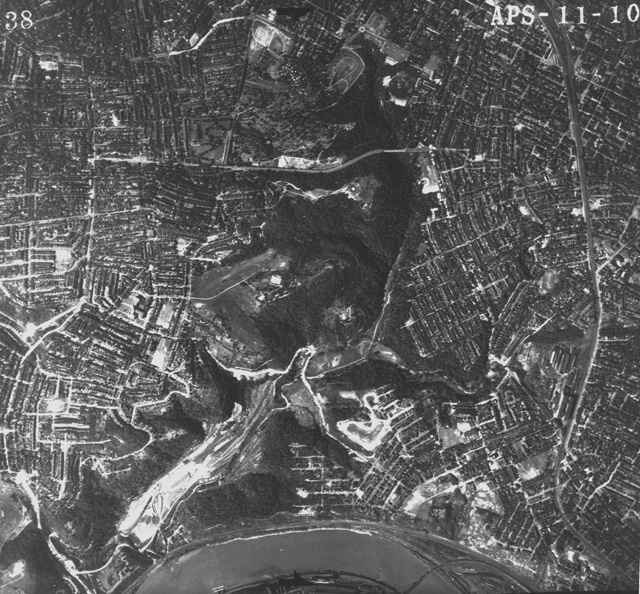
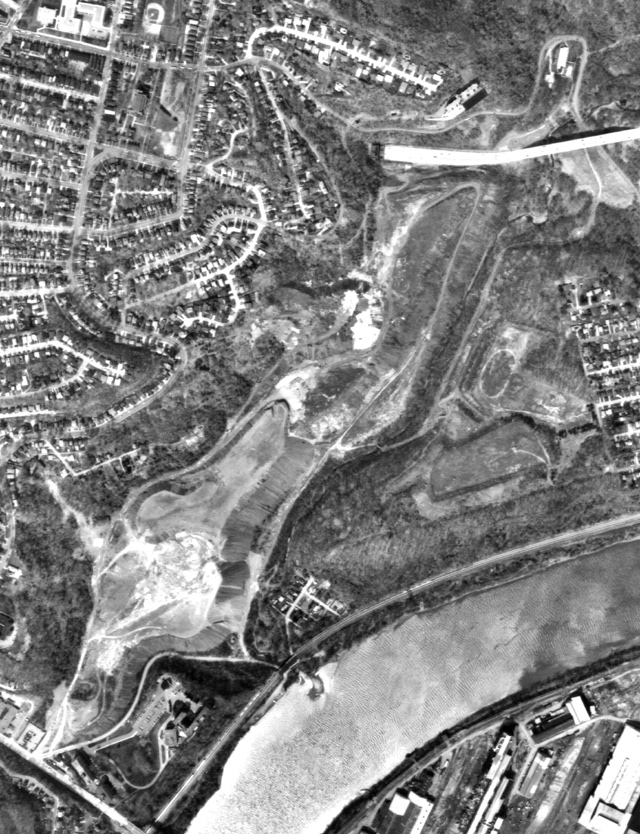
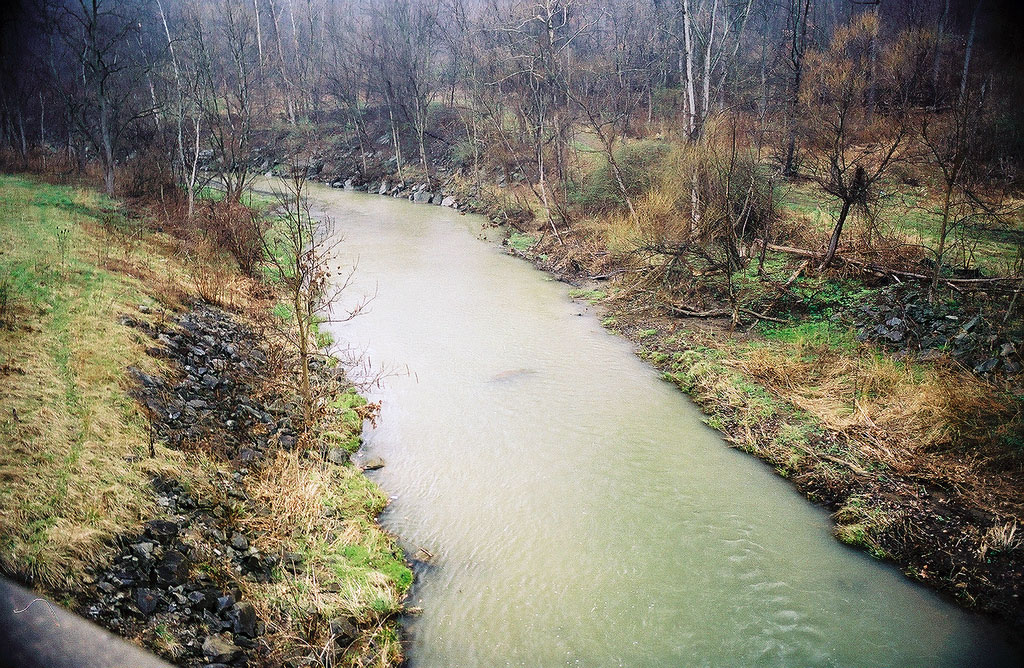
- 1 · The Nine Mile Run valleyFrom Frick Park through the slag dump to the Monongahela: a six-square-mile watershed and the last free-flowing surface stream in the historic city.
- 2 · The trailerA construction trailer in the proposed greenway, off Commercial Avenue, became the Community Resource and Research Center, open every weekend: a site of public expression.
- 3 · STUDIO for Creative Inquiry, Carnegie MellonThe project’s home, supported by the Heinz Endowments.
- 4 · WilkinsburgOctober 1998. The Re-Evaluating Stormwater design charrette, on retrofits that could restore an urban watershed’s hydrology.
- 5 · Schools and the Pittsburgh Children’s MuseumClassroom investigations of the brownfield with Homewood Montessori, Dickson Intermediate and John Minadeo schools.
- 6 · Wood Street Galleries, Pittsburgh1999. The final dialogue of three years: a two-floor installation seeking community consensus on the greenway’s design.
- 7 · Regina Miller Gallery, Carnegie Mellon2000. Nine Mile Run: Conversations in the Rust Belt.
- 8 · Contemporary Arts Center, Cincinnati2002. Ecovention, a survey of ecological art.
3
Research Strategies, Methodologies & Artistic Approaches
3.1 Ample Opportunity: a community dialogue
The first effort, in 1997, was an experiment in public discourse. For over a year the team worked to generate an informed public conversation about the open space, so that a motivated, knowledgeable constituency would be ready to take part in decisions. They treated the brownfield as an opportunity rather than a problem: the legacy of an industrial era that had effectively privatised the city’s rivers and streams, and a chance for the social reclamation of public use, value and aesthetics.
3.2 A roomful of disciplines
Scientists joined the artists:
- Sue Thompson and John Rawlins of the Carnegie Museum of Natural History inventoried the land’s biodiversity;
- Penn State geomorphologist Peggy Johnson and wetland scientist Andrew Cole analysed the stream;
- Carnegie Mellon engineer David Dzombak tested the water and traced failures in the sewers;
- landscape architect Ken Tamminga related landscape ecology to the design process;
- historians Joel Tarr and Andrew McElwaine reconstructed the valley’s history.
Pittsburgh City Planning gave access and guidance. An EPA grant funded test beds for creating diverse habitat on the slag soils, and in 1999 the team ran vegetation experiments on the lower slopes as grading began above.
3.3 Tools for discourse
The art took the form of tools for conversation: the trailer as a site of public expression, a pirate citizens’ radio station, the project website as a tool for civic debate, and a re-cartography of historic and romantic maps. The Wood Street show paired a history floor with a contemporary floor. On the first, slag, water, community and the changing landscape were told through photographs, quotes, a timeline and a history video. On the second, slag test beds, a ball of Nine Mile Run water rising and falling against texts about regulatory inaction, and the community’s design options were laid out for discussion.

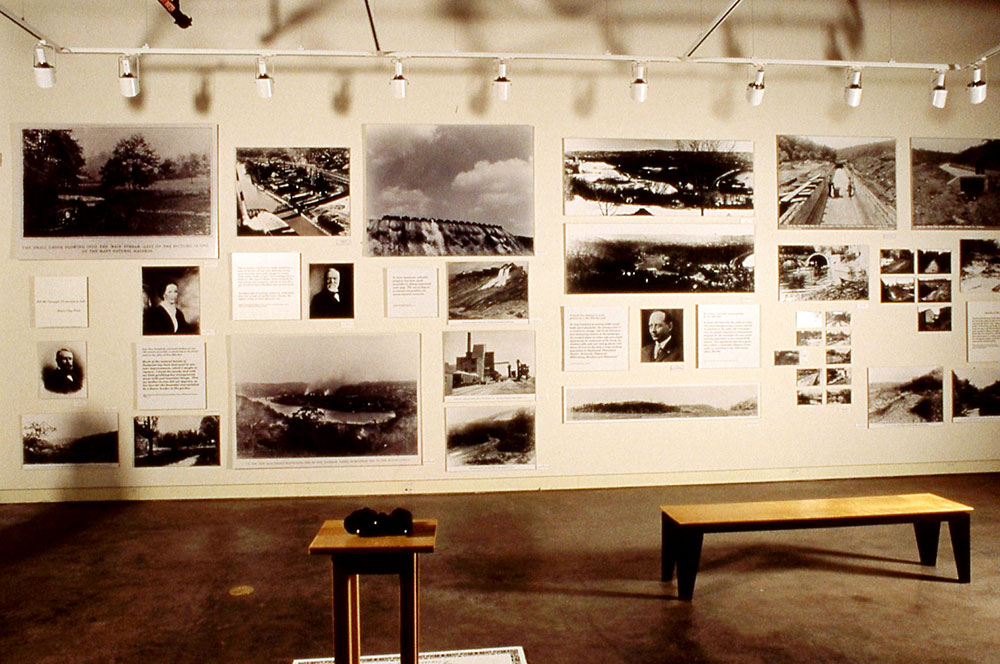
3.4 Plans the city could use
The team turned the dialogue into documents. With Pittsburgh City Planning it wrote the Nine Mile Run Watershed Rivers Conservation Plan, developed with community comment over six months, covering land, water, biology, culture, management and art. With the Rocky Mountain Institute, it produced Re-Evaluating Stormwater: The Nine Mile Run Model for Restorative Redevelopment (1999).
4
Conclusions
The greenway went ahead. The US Army Corps of Engineers began an ecosystem restoration of the stream in 2001, and the Nine Mile Run Watershed Association, founded the same year, carried the citizens’ work forward, towards Olmsted’s 1910 idea of a Frick Park that reaches the river.
For the artists, Nine Mile Run tested ideas about aesthetics, ecological recovery and a radical, discursive approach to art, planning and design. Looking for opportunities rather than simply fixing problems became the foundation of the studio’s later work, from 3 Rivers 2nd Nature across the region’s rivers to the forests and bogs of Scotland and Ireland.
Bibliography
Reading & references
Project publications
- Bingham, B., Collins, T., Goto, R. and Stephen, J. (1998) Ample Opportunity: A Community Dialogue. Pittsburgh: STUDIO for Creative Inquiry, Carnegie Mellon University. PDF
- Collins, T., Dzombak, D., Rawlins, J., Tamminga, K. and Thompson, S. (1999) Nine Mile Run Watershed Rivers Conservation Plan. Harrisburg: Pennsylvania Department of Conservation and Natural Resources. Online
- Ferguson, B., Pinkham, R. and Collins, T. (1999) Re-Evaluating Stormwater: The Nine Mile Run Model for Restorative Redevelopment. Snowmass, CO: Rocky Mountain Institute. PDF · Technical appendix
Writing by Collins & Goto
- Collins, T. and Goto, R. (1997) “Urban Reclamation: Place, Value, Use: The Nine Mile Run Project.” Leonardo 30(3). doi:10.2307/1576446
- Collins, T. and Savage, K. (1998) “Brownfields as Places: A Case Study in Learning to See Assets as Well as Liabilities, Opportunities as Well as Constraints.” Public Works Management & Policy 2(3). doi:10.1177/1087724×9800200304
- Collins, T. (2001) “The Rust Belt Dialogues: An Artist’s Concept Model for Public Dialogue about Urban Stream Restoration.” Ecological Restoration 19(3).
- Collins, T. (2002) “Conversations in the Rust Belt.” In Herzogenrath, B. (ed.) From Virgin Land to Disney World. Amsterdam: Rodopi. doi:10.1163/9789004333932_016 · PDF
- Collins, T. (2003) “Postindustrielle Landschaft – Nine Mile Run: Interventions in the Rust Belt.” In Genske, D. and Hauser, S. (eds) Die Brache als Chance. Berlin: Springer. doi:10.1007/978-3-642-55791-0_5
On the project site
- McElwaine, A. S. “Slag in the Park.” History and context
- Savage, K. “Art, Science, and Ecological Inquiry: The Case of 19th Century Landscape Painting.” Historical overview
- Collins, T. with Goto, R. (1996) “Urban Reclamation: Place, value, use. or, What does art have to do with it?” Essay
- Lacy, S. (ed.) (1995) Mapping the Terrain: New Genre Public Art. Seattle: Bay Press.
Also
Works & the project site
- Works: Nine Mile Run: Community Dialogues (1997–2000) · Nine Mile Run: Conversations in the Rust Belt · Nine Mile Run in Ecovention
- On the original site: the Wood Street Galleries show · research areas · the education programme · maps and images · the full team
- In the archives: Nine Mile Run Greenway Project Records (AIS.2006.19A), University of Pittsburgh Archives & Special Collections · the STUDIO for Creative Inquiry project page · Leonardo “Words on Works” · Public Art Online case study
- Next: 3 Rivers 2nd Nature (2000–2005), the same approach across the rivers of Allegheny County.
Credits
People
Project co-directors: Bob Bingham, Tim Collins and Reiko Goto, artists and research fellows; John Stephen, project coordinator, co-founder of Friends of the Riverfront and environmental attorney. STUDIO for Creative Inquiry director Bryan Rogers.
Research associates and assistants: Richard Pell, Jimmy Mathew, Karin Tuxen, Eva Tarbell, Jina Valentine and Doug Lambert. Consultants: Andrew Cole, David Dzombak, Peggy Johnson, Suzy Meyer, John Rawlins, Ken Tamminga, Joel Tarr and Sue Thompson, with David Lewis and John Buck. Pittsburgh City Planning: Joan Blaustein and John Rahaim.
Supported by the Heinz Endowments, with an EPA grant through the City of Pittsburgh for the slag habitat study. Project website by Herb Gilliland and Noel Hefele.